What "useful" means for a first tower defense release
A first release is useful when it answers one question you cannot answer on paper: do players understand the placement decision, and do they come back for the next stage? You do not need ten towers to learn that. You need enough variety that the choice of where and what to build matters, and few enough pieces that each one gets properly tuned.
Package prices next to studio quotes are covered in what a tower defense game costs. This guide is about the release scope: which towers, enemies and maps to keep, and which package that leaves you in.
Start with a tower and enemy matrix
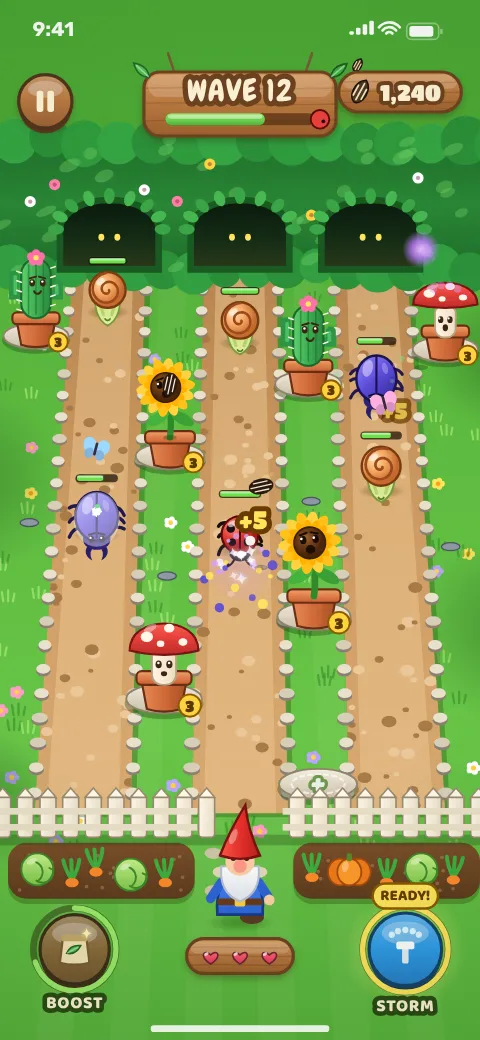
Give every tower one job and every enemy one question it asks of the player. If two towers answer the same question, cut one. Here is the matrix for a Core-sized version of our garden concept: three towers, four enemies, one environment.
| Enemy (question it asks) | Seed cannon (single target) | Cactus (short range, pierces) | Spore mushroom (area slow) |
|---|---|---|---|
| Beetle (baseline: can you build at all?) | Good | Good | Fair |
| Ladybug (fast: did you cover the exit?) | Weak | Good | Strong |
| Snail (armored: can you focus fire?) | Strong | Weak | Fair |
| Swarm of mites (many small: can you hit groups?) | Weak | Fair | Strong |
Each column has at least one Strong and one Weak, so every tower is worth building somewhere and none is enough on its own. Three towers and four enemies give you 12 matchups to balance, which is a sensible amount for a 10-business-day build. If you find yourself adding a fourth tower that is Good against everything, the matrix is telling you it would make the others pointless.
Then map stages to what they introduce
Stages are cheap when they reuse one environment and expensive when each needs new art. In an MVP, a new stage should introduce one thing or combine two things the player already knows. The schedule below is an illustration of how a compact stage set can be paced; your blueprint fixes the actual count.
| Stages | Lanes | New element | What the player learns |
|---|---|---|---|
| 1-2 | One | Seed cannon, beetles | Placement and wave timing |
| 3-4 | One | Cactus, ladybugs | Fast enemies need covered exits |
| 5-6 | Two | Snails | Focus fire on armor |
| 7-8 | Two | Spore mushroom, mites | Area slow against groups |
| 9-12 | Three | No new pieces; mixed waves | Combining all three towers |
| Final stage | Three | A tougher wave mix | A test of everything so far |
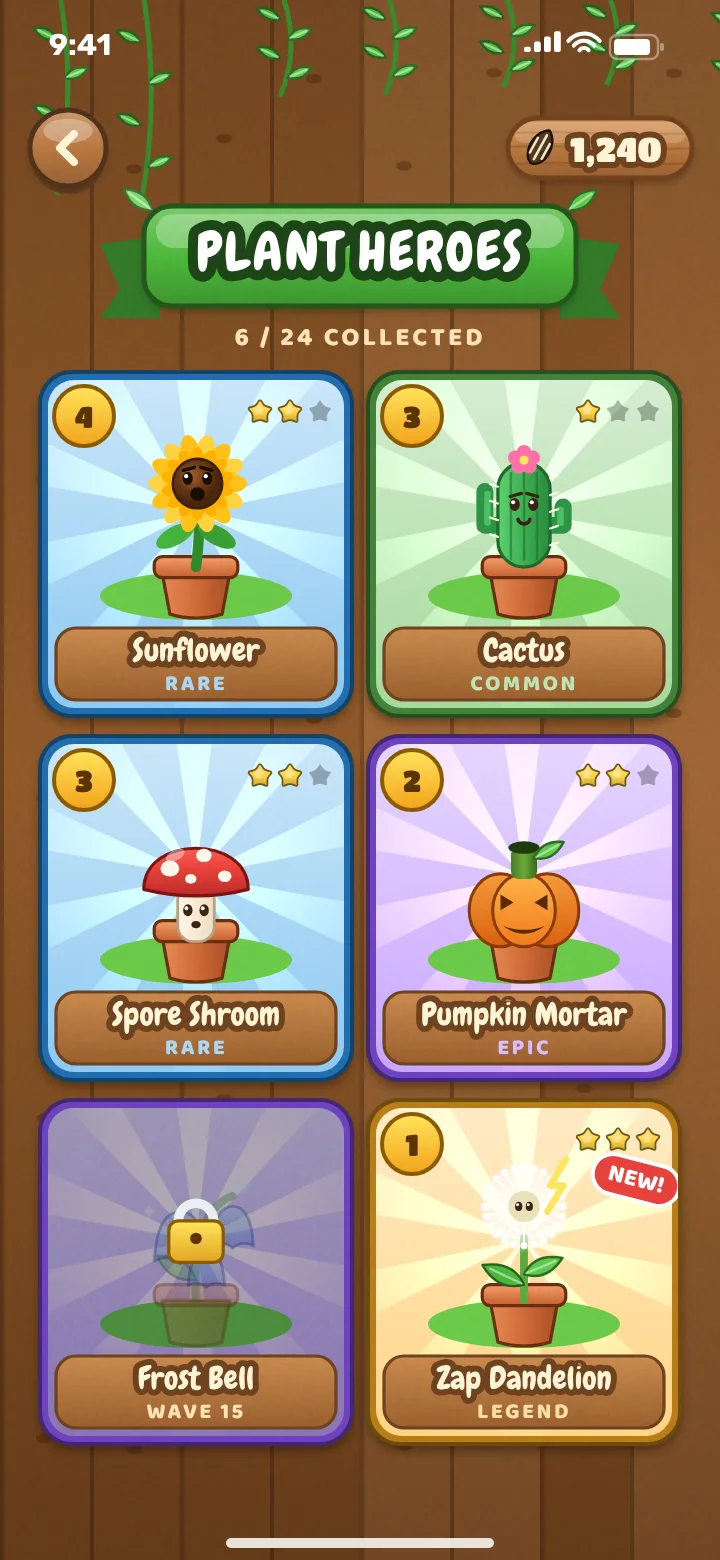
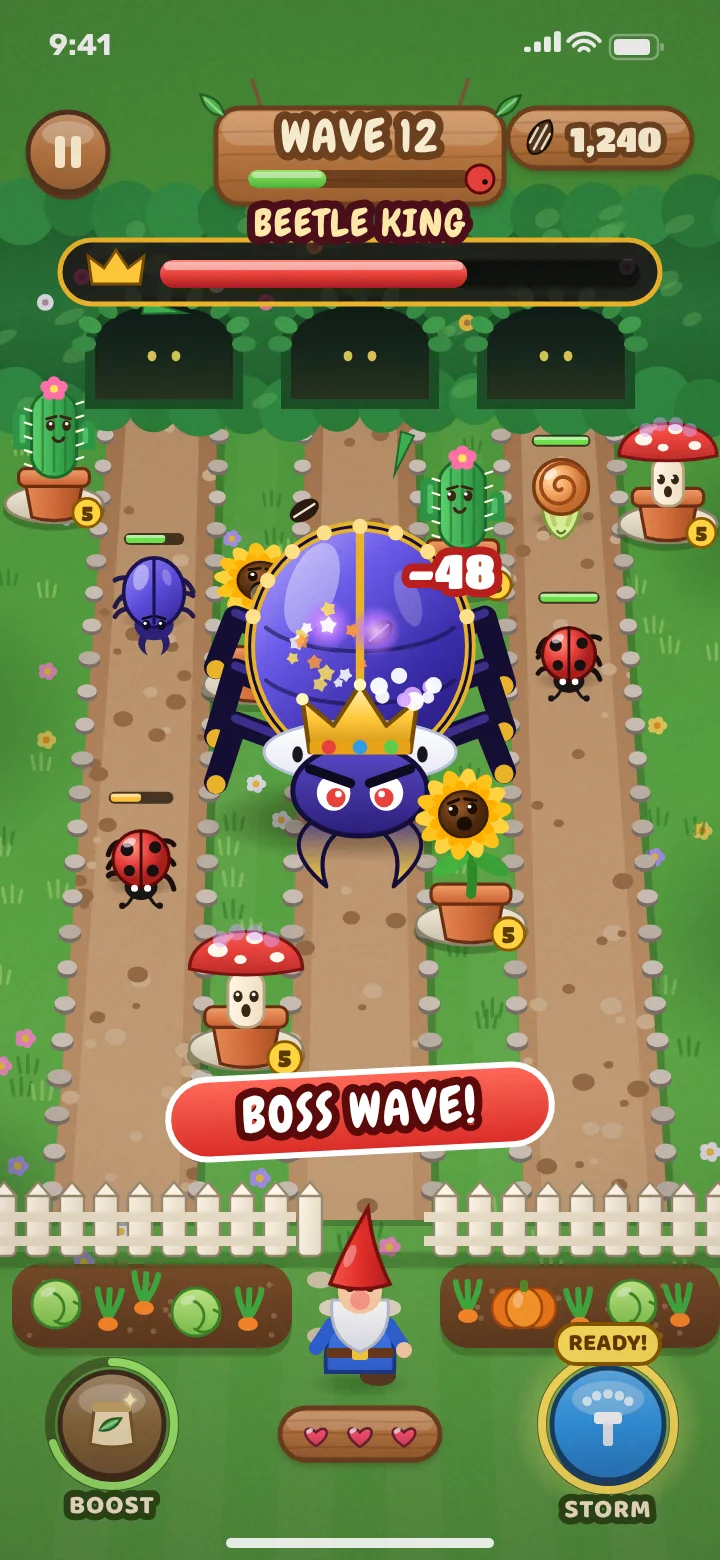
Notice what is missing: no boss, no hero, no ability button, no persistent upgrades. Each of those is a good feature and each is a system. The final stage can still feel like a climax through wave composition alone.
Core, Advanced or custom: a decision table
| If your first release needs | Route | Why |
|---|---|---|
| One environment, about three towers, a small enemy set, in-run upgrades | Core Game $499 | One primary loop with a bounded content set |
| The same, plus 16 launch creatives and 30 days of campaign management | Core Game + Launch $1,299 | Same build scope; ad spend paid separately |
| Multiple maps or world themes | Advanced Game + Launch $2,999 | Multiple maps are an Advanced signal |
| A hero, an ability such as a wave-wiping storm, or bosses | Advanced Game + Launch $2,999 | Each is a connected system beyond the core loop |
| Persistent tower unlocks, upgrade trees or mission goals | Advanced Game + Launch $2,999 | Needs a saved economy and metagame |
| Player-versus-player, map sharing, live server events | Custom quote | Needs a backend, moderation and running costs |
The rule we use: if the thing you want to learn from launch is whether players enjoy placing towers, buy Core. If it is whether they will stay for a metagame of heroes and unlocks, that metagame has to exist, and Advanced is the honest choice. Advanced targets a polished first playable within 10 business days, with the full submission-ready build normally completed within 30 days. Our tower defense service page shows the full Advanced concept those systems add up to.
What to cut first, and what to keep
- Cut the hero and ability layer before cutting towers. Three well-tuned towers teach more than five towers and a hero nobody balanced.
- Cut extra maps before cutting stages. Ten stages in one environment cost less than four stages across two.
- Cut persistent upgrades before in-run upgrades. In-run choices are part of the core decision.
- Keep the readability work. Enemies should differ by silhouette and speed, never by color alone, so players can read a wave at a glance.
- Keep a rewarded second chance after a lost wave. It is simple to build and fits how players already treat a near miss.
After the MVP ships
Watch where players stop. If most of them leave at the stage that introduces snails, the armor rule is unclear or the cannon is too weak; that is a tuning fix. If they finish every stage and leave, they wanted more content or more depth, which is the case for a second map or the hero system.
Unlimited refinements cover the approved blueprint until first submission. New maps, towers or systems after launch are new scope and are quoted separately; the maintenance guide explains how post-launch work is usually planned. If the MVP matrix above already describes your game, you can start the Core build.
Frequently asked questions
What is the smallest tower defense game worth launching?
One environment family, about three towers that each counter a different enemy, three or four enemy types and a compact stage set that introduces them one at a time.
Does a tower defense MVP need a boss?
No. A final stage with a tougher wave mix can work as a climax; bosses are a separate system that moves the build to Advanced.
Can I add a hero or special ability to a Core build?
Not usually. A hero or ability system is a connected system beyond the core loop, so it fits Advanced Game + Launch at $2,999.
How do I know which tower to cut?
Build a counter matrix of towers against enemy types; a tower that is good against everything or duplicates another tower's job is the one to cut.
Can I add maps after launch?
Yes, as new scope with its own quote. Unlimited refinements cover the approved blueprint until first submission.
Written and reviewed by the DFY Games team. Published ; facts checked . Prices and store rules change: check the linked sources before you rely on a figure.