Who this guide is for
This is for people commissioning an idle or tycoon game: founders, creators and brands who want one built and published under their own name. If you are looking for idle games to play, this is the wrong page. If you are pricing a build, the useful question is how much economy your idea needs, because in this genre the economy is the game.
Idle game cost at each scope
| Scope | Economy and content | Price | Timing |
|---|---|---|---|
| Core Game | One currency and production loop, one main scene, upgrade ladder, offline earnings with a cap, simple milestone or reset | $499 | Submission-ready build targeted in 10 business days |
| Core Game + Launch | The same build plus 16 launch creatives, 30 days of campaign management and one monetization iteration on early data | $1,299 plus ad spend | Same build target; campaigns run 30 days |
| Advanced Game + Launch | Multiple currencies and production chains, prestige, managers, missions, timed events, several locations | $2,999 plus ad spend | First playable in 10 business days, full build within 30 days |
| Custom quote | Server-run economy, live events calendar, trading between players | Quoted | Quoted |
Our example idle tycoon concept is marked "best for Core + Launch", and the reason is commercial: an idle game earns mainly through rewarded boosts and a starter pack, both of which need a steady flow of players. The launch package gives you creatives built around the moments idle games sell on (tiny stand to empire, the upgrade chain, the offline earnings reveal). The idle tycoon game page has the full package details.
What a bounded economy looks like
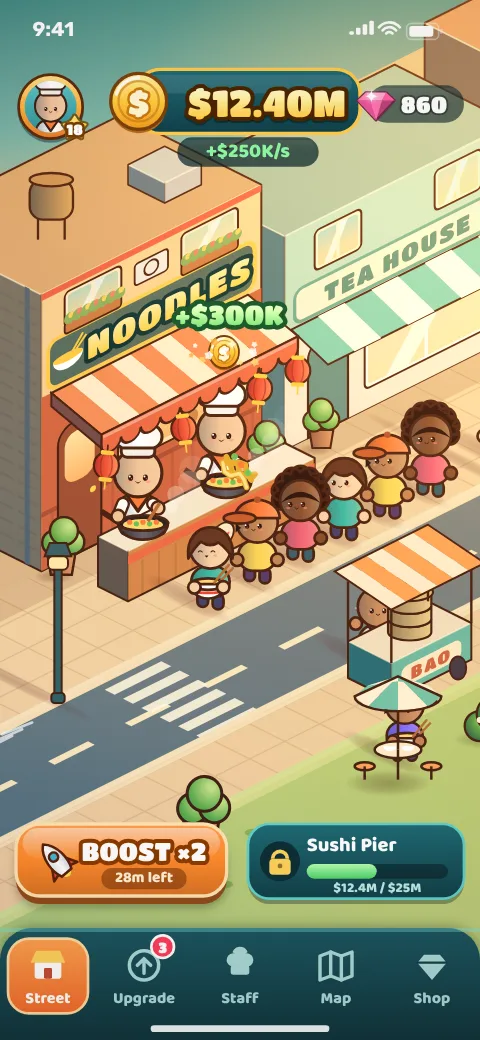
Bounded means the whole economy fits on one sheet and every number on it can be tested before launch. In our example concept that is a noodle street: tap to earn, buy a station upgrade, automate it, collect while away, expand. One currency, one scene, a ladder of stations that each cost more and earn more.
- One soft currency, earned by taps and by automated stations
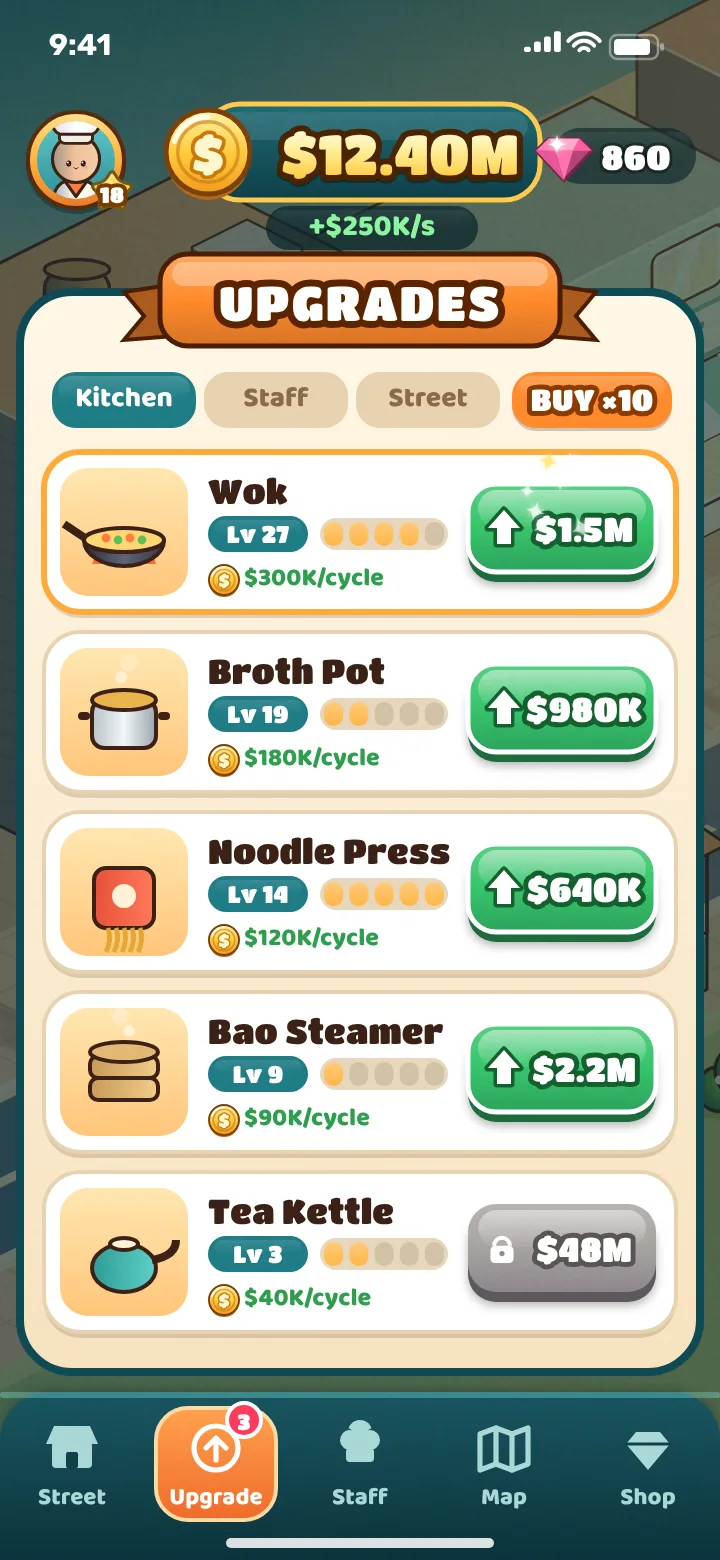
- A ladder of stations with rising costs and outputs
- Milestone bonuses at fixed levels (for example, output doubles at level 25)
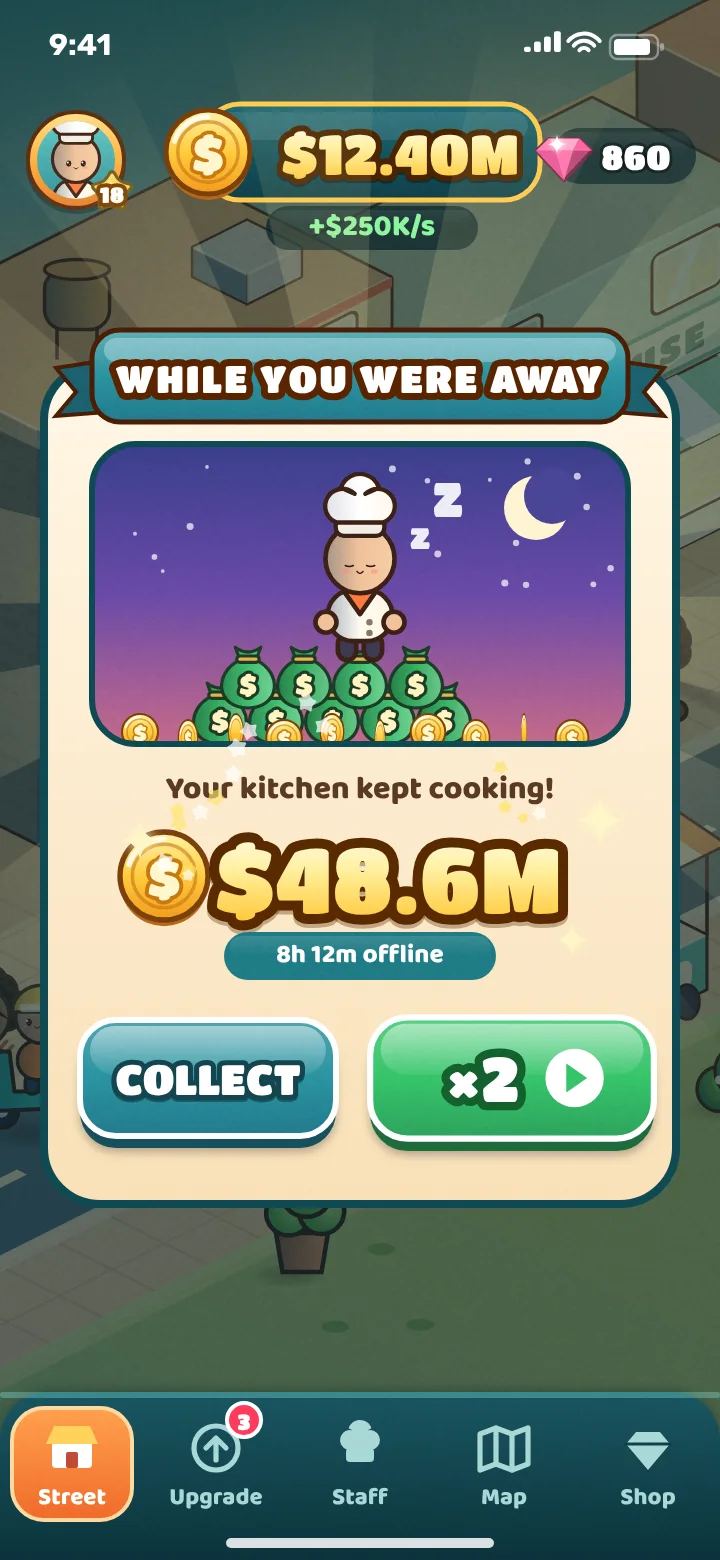
- Offline earnings, calculated on return and capped
- A rewarded ad that doubles a collection or speeds up time for a while
- A starter pack and a remove-ads purchase
The idle economy scoping guide shows a working sheet for this kind of economy and how to read it.
Offline progress and its limits
Offline earnings are what make idle games feel generous, and they are also where a bounded build has to be honest about limits.
| Question | Core build | Deeper build |
|---|---|---|
| How is time away measured? | From the device clock at last save and on return | From a server timestamp, which needs a backend |
| How much can a player earn away? | A fixed cap, e.g. a few hours of income | Caps that grow with upgrades or managers |
| Can players cheat by changing the clock? | Possible; the cap limits the damage | Server time closes most of that gap |
| What does the rewarded ad do? | Doubles the collection on return | Several boosts, timed events, offers |
| Does progress move between devices? | No, local save only | With accounts and cloud save, where scoped |
The cost of deeper connected systems
Each system below is reasonable on its own. The cost comes from connecting them: every new currency or modifier changes the pacing of everything else, so the sheet has to be rebalanced and retested as a whole.
| System | What it adds | Where it fits |
|---|---|---|
| Prestige | A reset that pays out a second currency with its own upgrade tree | Advanced |
| Managers collection | Characters with rarity and perks that modify stations | Advanced |
| Second location or district | A new scene, new stations and a transfer of progress | Advanced |
| Missions and quests | Goals that steer what the player buys next | Advanced |
| Timed events | Temporary economies with their own rewards | Advanced; ongoing events are a separate quote |
| Server economy or trading | Backend, accounts, anti-cheat | Custom quote |
Our example concept shows managers and a district map in its art. In a Core build those would be scoped down (one automation unlock per station, one street), and the full managers collection and extra districts are what an Advanced blueprint would add.
The screens a Core idle game needs
Idle games have fewer screens than buyers expect, because most of the game happens on one scene. A typical Core list:
| Screen | Purpose |
|---|---|
| Main scene | The street or shop that grows, tap to earn, coin pops |
| Upgrade panel | Every station with level, cost and output |
| Welcome back | Offline earnings with a rewarded double |
| Boost offer | Rewarded ad for a timed income boost |
| Milestones | What the next milestone gives and how close it is |
| Shop | Starter pack and remove ads |
| Settings and consent | Sound, privacy, ad consent where required, restore purchases |
A managers collection, a district map, a missions list and an events screen would each add a screen and a system. That is the practical difference between the two tiers: Core polishes one scene and one panel deeply, Advanced spreads the work across several connected screens.
Studio ranges and costs outside the build
For context, Innovecs Games lists 2026 studio ranges of $15,000 to $35,000 for a simple casual game and $30,000 to $150,000 for a casual game with progression, which is where most idle games with prestige and events land. It also notes user acquisition often runs at 30% to 100% of the development budget.
Whatever you build, you also pay Apple $99 a year and Google $25 once for developer accounts, plus any ad spend. The guide to how mobile games make money explains the rewarded-ad and IAP mix an idle game relies on.
Sources: [S18]: Innovecs Games, How Much Does Mobile Game Development Cost in 2026? (opens in a new tab)[S19]: Apple Developer, Enrollment (opens in a new tab)[S20]: Google Play Console Help, Get started with Play Console (opens in a new tab)
Frequently asked questions
How much does it cost to develop an idle game?
A bounded idle game with one currency and one scene costs $499 as a DFY Core build or $1,299 with a launch campaign. Studio quotes for a casual game with progression run $30,000 to $150,000.
Is prestige included in the Core package?
A simple reset or milestone system fits Core. A full prestige layer with its own currency and upgrade tree is an Advanced feature.
How are offline earnings limited?
In a Core build they are calculated from the device clock and capped at a fixed amount of income, which protects pacing and limits clock cheating.
Why is Core + Launch recommended for idle games?
Idle games earn mostly from rewarded boosts and small purchases, which only add up with a steady stream of players, so a planned launch matters more than in some genres.
Can I add events or new districts later?
Yes. You own the game files after full payment, and new systems can be added later under a separate quote.
Sources
- [S18] Innovecs Games, How Much Does Mobile Game Development Cost in 2026?
- [S19] Apple Developer, Enrollment
- [S20] Google Play Console Help, Get started with Play Console
Written and reviewed by the DFY Games team. Published ; facts checked . Prices and store rules change: check the linked sources before you rely on a figure.