Why the sheet comes before the art
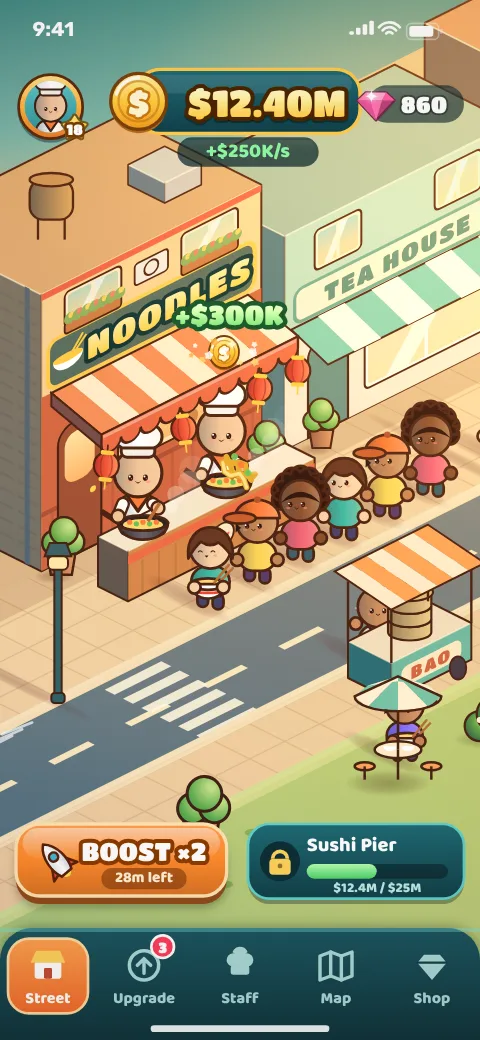
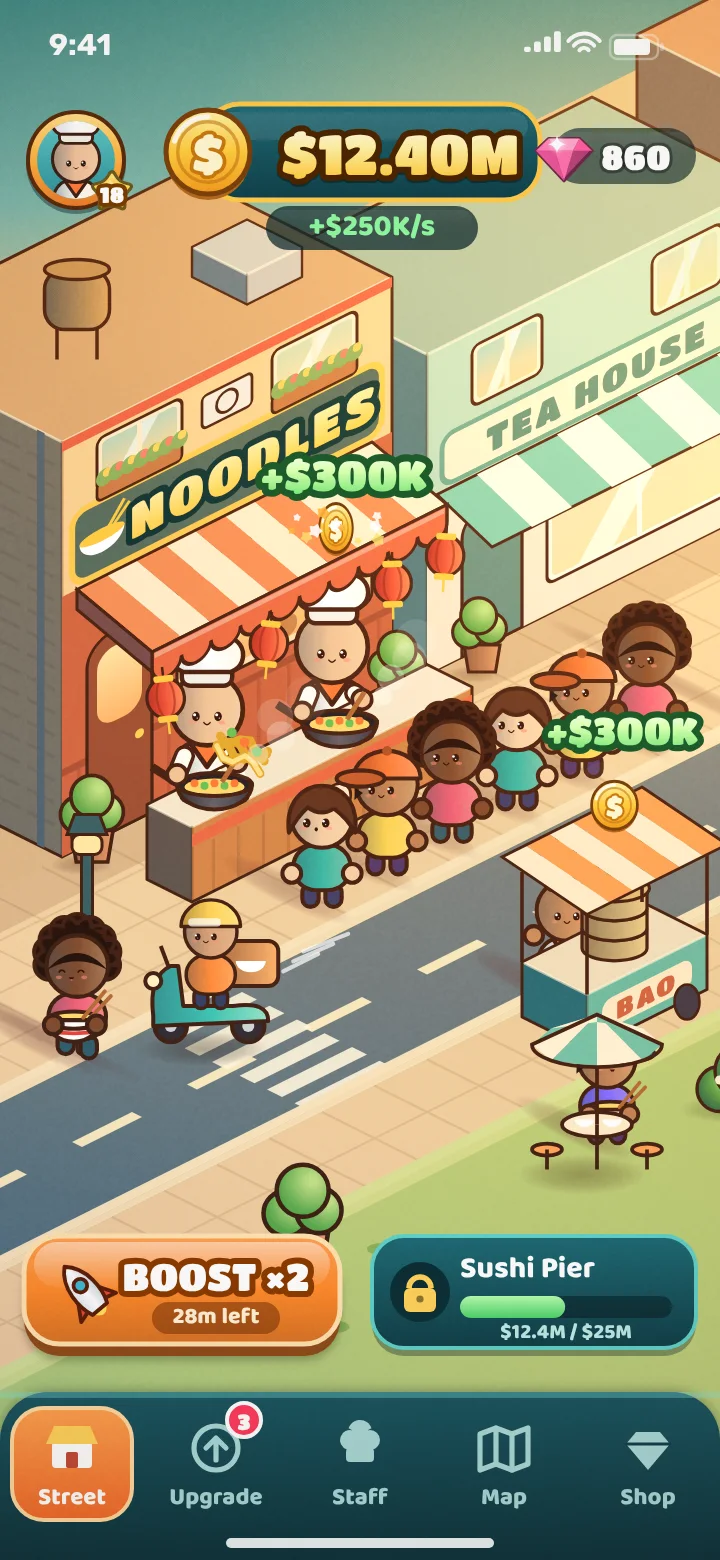
In an idle game, pacing is the product. If the third station costs too much, players stall and leave; if it costs too little, they run out of things to buy by day two. Our example idle tycoon concept plans its upgrade costs in an economy sheet before any art is made, so pacing can be tested early. You can do a rough version of the same exercise before you commission anything, and it will tell you which package you need.
A working economy sheet
Here is a first-pass sheet for a noodle street with six stations. The numbers are illustrative and were picked to show the method; they will change in tuning.
| Generator | Base cost | Cost multiplier | Base output / sec | Unlock |
|---|---|---|---|---|
| Noodle cart | $4 | 1.07 | $1 | Start of game |
| Wok station | $60 | 1.15 | $8 | Noodle cart level 10 |
| Broth pot | $720 | 1.14 | $45 | Wok station level 10 |
| Noodle press | $8,640 | 1.13 | $260 | Broth pot level 10 |
| Steamer | $103,680 | 1.12 | $1,500 | Noodle press level 10 |
| Tea kettle | $1,244,160 | 1.11 | $9,000 | Steamer level 10 |
| Rule | Example value | What it controls |
|---|---|---|
| Milestone bonus | Station output ×2 at levels 25, 50 and 100 | Gives players a target inside each station |
| Offline cap | 2 hours of income | How much a returning player can collect |
| Rewarded double | ×2 on the offline collection | The main rewarded-ad moment |
| Tap value | Equal to one second of noodle cart output | Keeps tapping useful early, irrelevant later |
How to read it: three pacing checks
- Payback time. Base cost divided by base output gives how long a new station takes to pay for itself: about 4 seconds for the cart, 7.5 for the wok, 16 for the broth pot, then 33, 69 and 138 seconds. Roughly doubling at each step makes every new station feel like a bigger decision without a sudden wall.
- Cost growth. With a 1.15 multiplier the wok station's tenth level costs about $211, and reaching level 10 from scratch costs about $1,218 in total. Higher multipliers make a station top out sooner and push players towards the next one.
- Offline value. A player earning $500 a second with a 2-hour cap collects up to $3.6 million on return, or $7.2 million with the rewarded double. Compare that with the next purchase on the sheet: if one collection buys three stations at once, the cap is too generous.
What each package can support
| Economy feature | Core / Core + Launch | Advanced + Launch |
|---|---|---|
| Currencies | One soft currency | Several currencies |
| Generators | One ladder in one scene | Several chains or locations |
| Milestones and reset | Fixed milestones, simple reset | Prestige with its own upgrade tree |
| Automation | One unlock per station | Managers with perks and rarity |
| Offline earnings | Device clock, fixed cap | Caps that grow; server time where scoped |
| Monetization | Rewarded boost, starter pack, remove ads | Offers, bundles, deeper IAP economy |
| Tuning after launch | One monetization iteration with Core + Launch | One iteration plus analytics event map |
The sheet above, with one currency and six stations, is the kind of economy the Core tier is built for. If your sheet needs a second tab for prestige or a second currency, it is an Advanced brief. Either way, the written blueprint confirms the final numbers of stations, screens and systems at kickoff. The idle tycoon package page shows both routes.
Common sheet mistakes
- One multiplier for every station. If every station grows at the same rate, the newest one is always the best buy and older stations become dead weight.
- Unlocks that depend on total earnings only. Players lose track of what they are working towards; tying each unlock to the previous station's level gives a visible next step.
- No milestone bonuses. Without them, levelling a station past its first ten levels feels pointless and the ladder gets skipped.
- Offline cap set by feel. Compare one full offline collection with the next purchase on the sheet: if it buys the next three tiers at once, the cap is too high.
- Purchases that break the curve. A starter pack that multiplies all income permanently can make the rest of the sheet trivial. Price and size it against the sheet.
None of these need code to spot. A spreadsheet with the formulas from the table above shows most of them within an hour of trying, which is a cheap hour compared with retuning a finished build.
| If your sheet has | It suggests |
|---|---|
| A second tab for a prestige currency | Advanced |
| Generators that consume another generator's output | Advanced (production chains) |
| Multiple scenes with their own ladders | Advanced (several locations) |
| Values that change on a schedule after launch | Separate quote for live operations |
Before you commission
Idle economy brief
- Theme and the thing that grows (a stand, a street, a factory)
- One currency, or a clear reason you need more
- A generator list with rough costs and outputs, even if the numbers are guesses
- How players unlock the next generator
- What milestones reward
- How long a player can be away and still collect
- Where the rewarded ad appears and what it gives
- Which two purchases, if any
Package prices and studio ranges are covered in what an idle game costs at each scope. For the parts of a brief every genre shares, use the mobile game brief template.
Frequently asked questions
What is an idle game economy sheet?
A table of every generator with its base cost, cost multiplier, output and unlock condition, plus rules for milestones and offline earnings. It is used to test pacing before art is made.
What cost multiplier should an idle game use?
There is no single right value. Most sheets use a multiplier a little above 1 per level, and the final values come from testing payback time and unlock pacing.
Do I need to give the developer exact numbers?
No. A rough sheet with guesses is enough to show the structure; the developer sets and tunes the values during the build.
Does a prestige system fit the Core package?
A simple reset fits Core. Prestige with a second currency and its own upgrade tree is scoped in Advanced.
Written and reviewed by the DFY Games team. Published ; facts checked . Prices and store rules change: check the linked sources before you rely on a figure.