The launch list for a small shooter
A first release has one job: show that the core run is fun enough that players come back. Everything on the launch list should serve that run, and everything else waits. The split below assumes the Core shape of one ship, one mode and one environment described on the space shooter game page.
| Area | At launch | Can wait for an update |
|---|---|---|
| Ships | One ship that feels good to move | Extra ships, ship skins |
| Mode | One run of sectors with a clear end | Endless mode, boss rush, daily runs |
| Waves | Enough to teach every enemy and then mix them | Extra sectors |
| Bosses | At least one, ideally one per sector on a shared rig | Bosses with new mechanics |
| Power-ups | Two or three, readable at a glance | Rare or stacking power-ups |
| Upgrades | A short ladder for a few ship stats | Upgrade trees, loadouts |
| Revenue | Rewarded revive, remove-ads, one simple purchase | Offers, bundles, battle passes |
| Settings | Sound, music, haptics, a reduced-effects option | Control customization |
| Social | Local best score | Online leaderboards (these need accounts and a backend) |
A wave plan for the first release
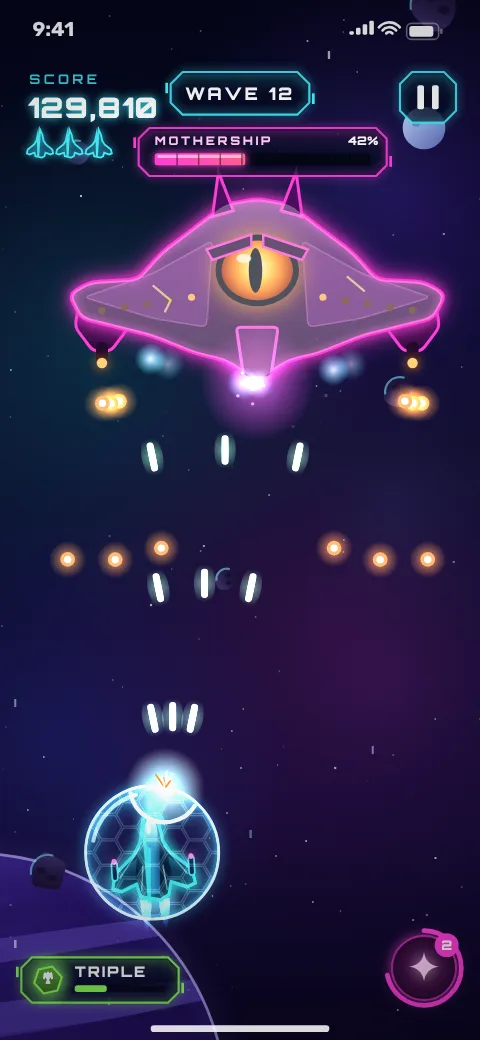
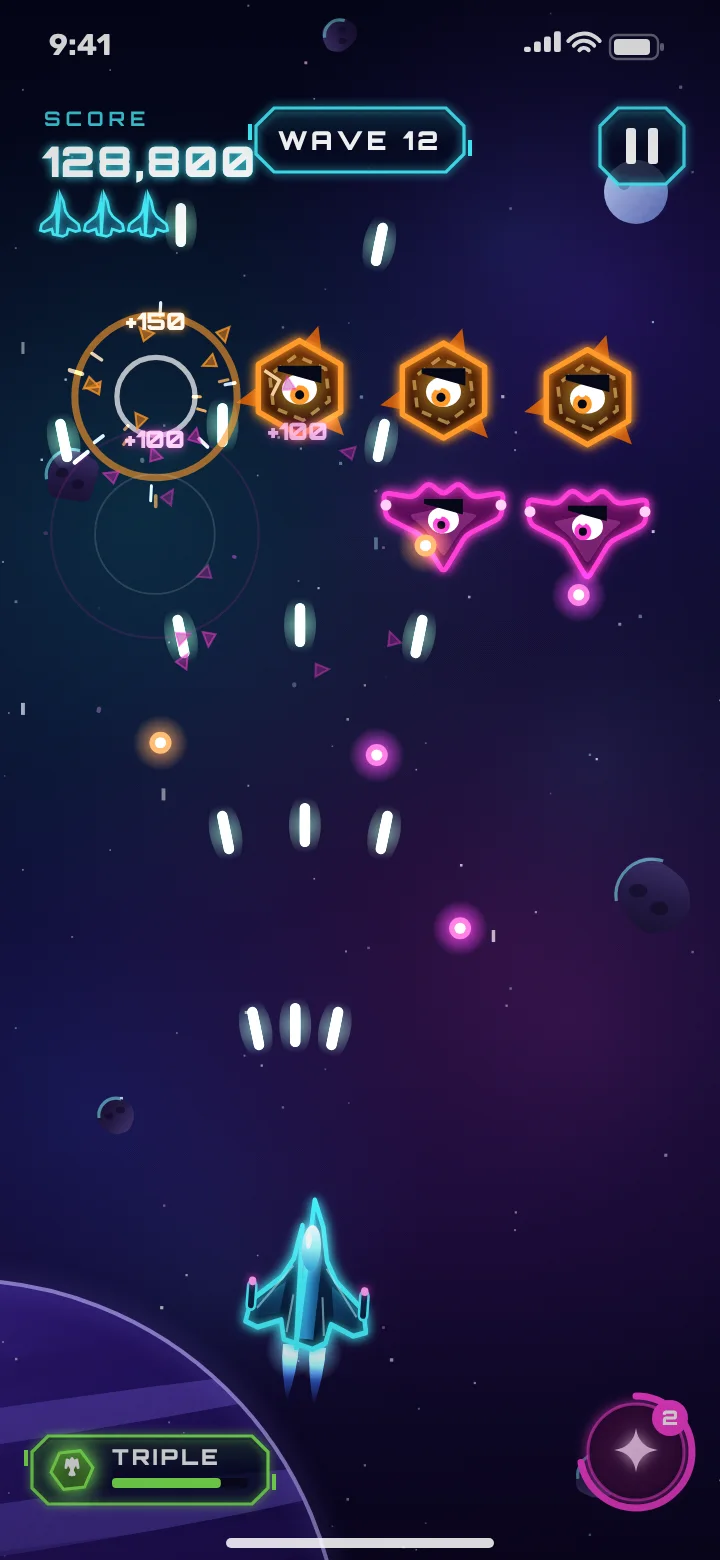
A wave plan is the shooter's level design. It decides when each enemy appears, when the player gets stronger and where the pressure peaks. Our example space shooter concept starts with auto-fire on; the first wave teaches dodging and the second drops a triple-shot power-up. The plan below extends that pattern across the first sector.
| Wave | Enemy mix | What it teaches | Power-up | Pressure |
|---|---|---|---|---|
| 1 | Drifters in a slow line, firing straight down | Move to dodge; firing is automatic | None | Low |
| 2 | Drifters in a V formation | Wider spreads are worth having | Triple shot | Low |
| 3 | Divers that swoop at the ship | Watch the edges, not only the front | None | Medium |
| 4 | Drifters and divers together | Prioritize the threat that moves | Shield | Medium |
| 5 | A breather: a few drifters and a credit shower | Reward and recovery before the boss | Triple shot | Low |
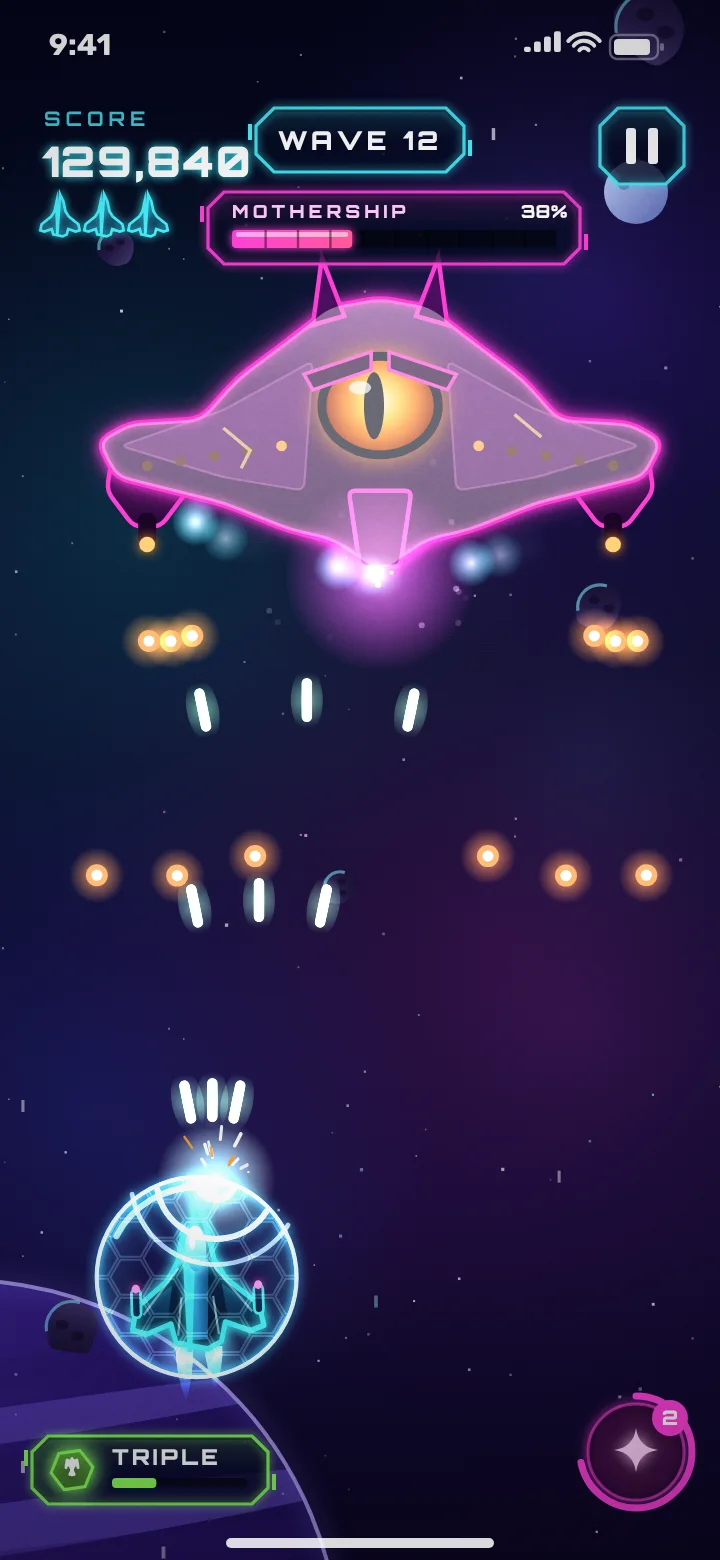
| 6 | Boss: mothership with two attack patterns | Read the warning, then dodge | Drops mid-fight | High |
- Introduce one new thing per wave, then combine it with what the player already knows.
- Put a quieter wave right before each boss so players arrive with full attention.
- Later sectors reuse the same enemies in new mixes and speeds; one new enemy per sector is plenty.
- Keep enemy bullets in a warm palette and the player's in a cool one, as our example concept does, so threats read instantly.
Performance notes for low-end phones
Shooters are among the hardest casual games on cheap phones. Every bullet, explosion and glow effect is drawn every frame, and the worst moment (a boss firing while a wave explodes) is also the moment players care about most. Core builds are tested across a representative device matrix, with a performance check in the device QA days before submission. Ask for the results as numbers you can read, using a sheet like this one:
| Test | How to run it | Budget you agree | Measured on the cheapest test phone |
|---|---|---|---|
| Peak bullets on screen | Debug counter during the busiest wave and the boss | A cap agreed in the blueprint | To record |
| Peak particles | Debug counter during a chain of explosions | A cap, with lower settings for weak devices | To record |
| Frame rate in the busiest wave | On-screen frame counter or a profiler capture | Your target, for example 60 fps | To record |
| Frame rate after sustained play | Play continuously for 15 minutes, then repeat the busiest wave | Same target, allowing for heat | To record |
| Cold start to first wave | Stopwatch from tapping the icon | A number you are happy with | To record |
| Memory during the boss fight | Profiler capture | Inside the device's comfortable range | To record |
| Touch response | Drag quickly side to side and watch the ship follow | No visible lag | To record |
- Bullets and enemies should come from object pools, created once and reused, so the game does not stutter when spawning.
- Glow is cheaper as pre-drawn sprites than as a full-screen bloom effect; keep real-time bloom for stronger devices if at all.
- Cap particle counts and degrade gracefully: fewer sparks per explosion on weak phones, never fewer bullets the player has to dodge.
- Limit how many explosion sounds play at once; dozens of overlapping sounds cost performance and sound worse.
- Test on a phone that has been charging or in a warm room. Heat throttles the processor and is where frame rate drops show up.
Monetization that suits a first release
Our example concept keeps revenue simple: a rewarded revive, rewarded upgrade boosts and a remove-ads purchase. A revive offered right after a close loss to a boss is a fair trade for the player: one short video for another try at the fight they nearly won. Interstitials belong between sectors or after the results screen, never mid-wave; Google's AdMob guidance asks for interstitials at natural transition points and warns against placements that cause accidental clicks.
Hold back on economy depth at launch. Upgrade prices you set before anyone has played are guesses, and a first update that rebalances them using real play data is normal.
Sources: [S13]: Google AdMob, Interstitial ad guidance (opens in a new tab)
Store page, testers and launch creative
Our example concept's store treatment shows boss fight and power-up moments, one per screenshot, and its ad angles are a screen-filling triple shot, a last-second dodge and a boss takedown. Those moments only exist if the game has them at launch, which is another reason to ship at least one good boss. Core Game + Launch adds 16 creatives (up to 8 short vertical videos and 8 static or story variants) and 30 days of campaign management.
Plan the store calendar too. New personal Google Play developer accounts need at least 12 testers opted in to a closed test for 14 days before applying for production access; DFY coordinates up to 15 invited playtesters, but the account owner stays responsible for eligibility. Apple and Google control review timing and approval.
Sources: [S6]: Google Play Console Help, Testing requirements for new personal developer accounts (opens in a new tab)[S7]: Google Play Console Help, Publish your app (opens in a new tab)[S8]: Apple Developer, App Review (opens in a new tab)
Deciding what goes into the first update
Let early play decide. If most players stop at the first boss, tune that boss before adding anything. If players finish every sector quickly, a new sector built from existing enemies is the cheapest addition. A second ship or an endless mode is new scope and gets quoted separately. The mobile launch checklist covers the submission steps, and the space shooter cost comparison shows where each addition sits in price.
If this launch list matches your idea, you can start the build and confirm the wave plan in the blueprint.
Frequently asked questions
How many waves should a small shooter launch with?
Enough to teach every enemy type and then combine them, ending in at least one boss. A few sectors of around six waves each is a common shape, confirmed in the blueprint.
Should I launch with more than one ship?
Usually not. One ship that feels good is worth more than three that feel similar, and extra ships make a natural first update once players ask for them.
What should I test on low-end phones?
Peak bullet and particle counts, frame rate in the busiest wave and after 15 minutes of play, cold start time, memory during the boss fight and touch response.
Will DFY Games tell me the measured frame rate?
Core builds include a performance check during device QA. Ask for the test phone and the measured figures for the busiest wave so you can judge them yourself.
Where should ads appear in a shooter?
Rewarded ads for revives and boosts, chosen by the player, and interstitials only between sectors or after results, never during a wave.
Sources
- [S13] Google AdMob, Interstitial ad guidance
- [S6] Google Play Console Help, Testing requirements for new personal developer accounts
- [S7] Google Play Console Help, Publish your app
- [S8] Apple Developer, App Review
Written and reviewed by the DFY Games team. Published ; facts checked . Prices and store rules change: check the linked sources before you rely on a figure.