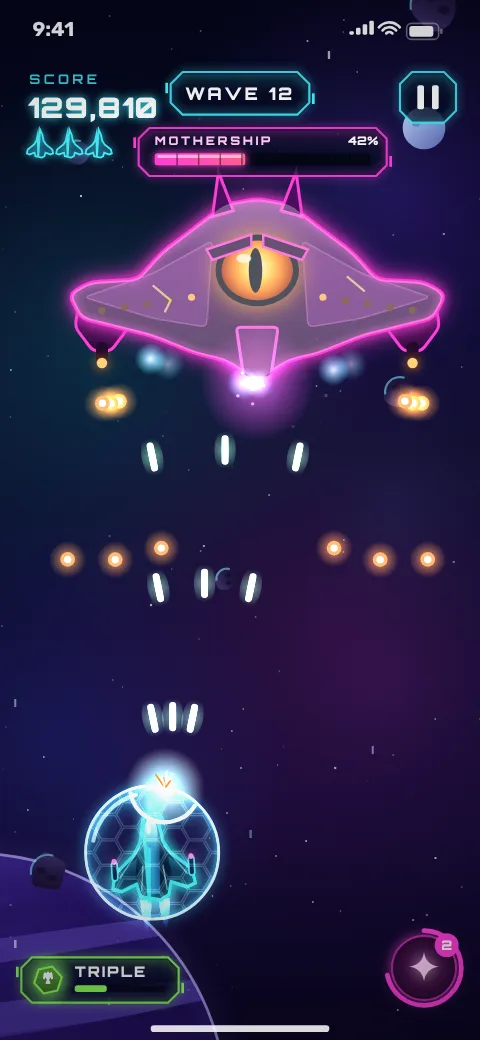
The five things that set a shooter's price
A space shooter brief gets priced by counting things. "A shooter with bosses and upgrades" can mean a two-week build or a year of work, so it helps to name the units the studio will actually build and test:
| Unit | What it is | What makes it expensive |
|---|---|---|
| Wave | A scripted group of enemies with an entry path, a formation and a firing pattern | Hand-authoring many waves, each needing its own balance pass |
| Enemy type | One look, one movement pattern and one attack | New behaviors (homing, shields, splitting) need code, art and tuning each |
| Boss | A large enemy with a health bar and attack phases | Multiple phases, unique art per boss, readable warnings before each attack |
| Upgrade | A permanent improvement bought between runs, or a power-up picked up during one | Branching trees, several currencies and balancing every path |
| Environment | The background art, scroll direction, lighting and any hazards | Each new setting is a new art set plus a readability check for bullets |
Waves are the cheapest unit to add once enemies exist, because they recombine what is already built. Environments are the most expensive, because they touch art, performance and readability at once.
Space shooter scopes compared
| Scope | Waves and enemies | Bosses | Upgrades | Environment | Route and price |
|---|---|---|---|---|---|
| Focused shooter | A curated wave set built from a small enemy set; up to three weapons or fire modes | A few pattern-based bosses that reuse the bullet system | Simple ladder for a few ship stats; in-run power-ups | One deep-space setting | Core Game, $499; with launch, Core Game + Launch, $1,299 |
| Deeper shooter | Enemy classes with distinct roles, missions, a second mode such as endless or boss rush | A boss per map with phases | Upgrade tree, multiple ships or loadouts | Typically three to five maps | Advanced Game + Launch, $2,999 |
| Online or live shooter | Co-op or versus play, matchmaking, events | Raid-style or shared bosses | Accounts, server-side economy | Any | Custom quote |
Package prices exclude ad spend, Apple's $99 yearly developer fee and Google Play's $25 one-time fee. Advanced targets a polished first playable in 10 business days and completes the full build within 30 days.
Sources: [S19]: Apple Developer, Enrollment (opens in a new tab)[S20]: Google Play Console Help, Get started with Play Console (opens in a new tab)
What one environment really limits
"One main environment" is the Core limit buyers most often misread. In a shooter it means one background art family, one camera and scroll direction, one playfield size and one set of hazards. Inside that, a lot can change: which enemies appear, how fast they move, how dense the bullets get, the music intensity and the color accents of each sector.
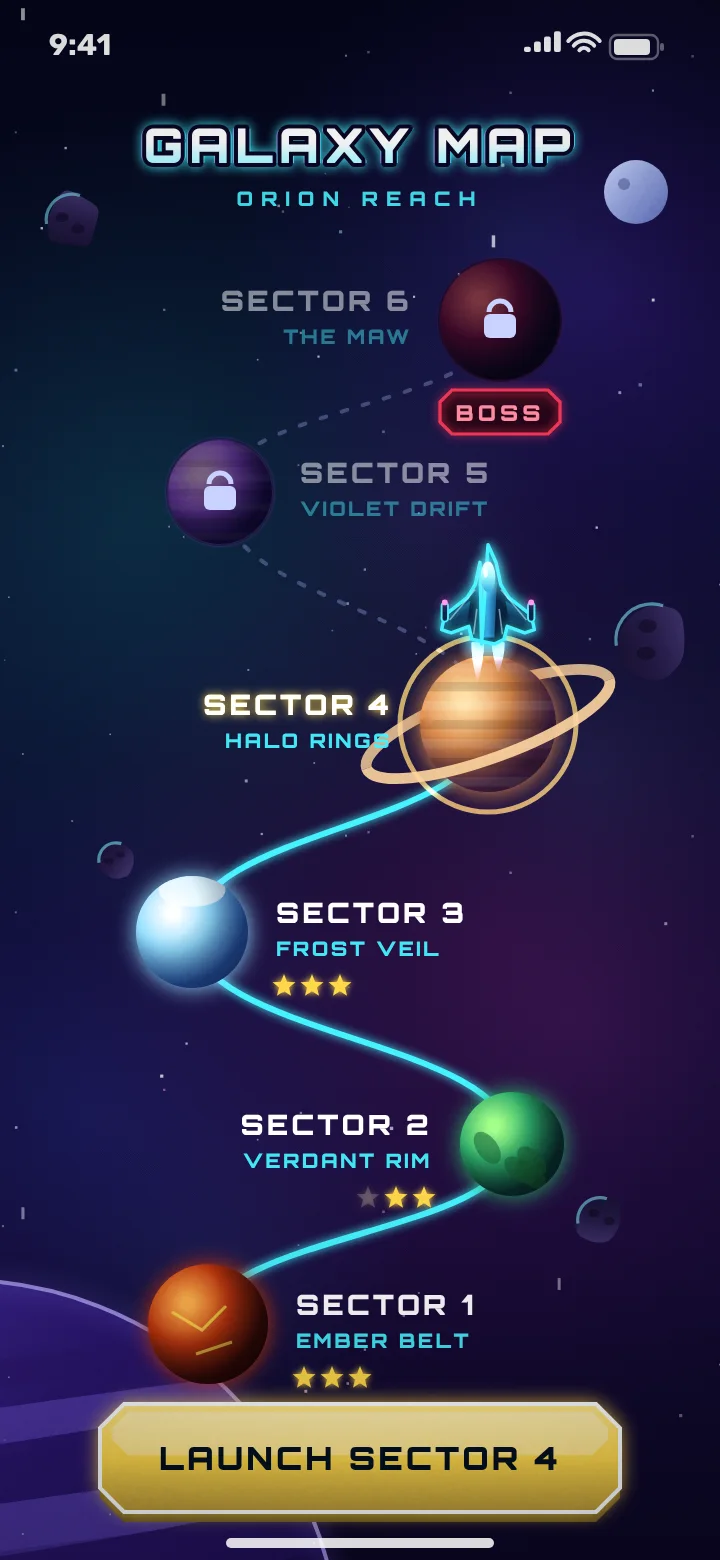
Leaving it means building something new: an asteroid field where rocks collide with the ship, a run across a planet's surface, a side-scrolling stage, an interior base. Each needs new art, new collision rules and a fresh check that bullets still read against the background. Our example space shooter concept stays inside one environment. Its galaxy map shows planets as sectors along a path, but every fight happens in the same neon-on-deep-space setting with different wave mixes.
A sample Core-sized shooter brief
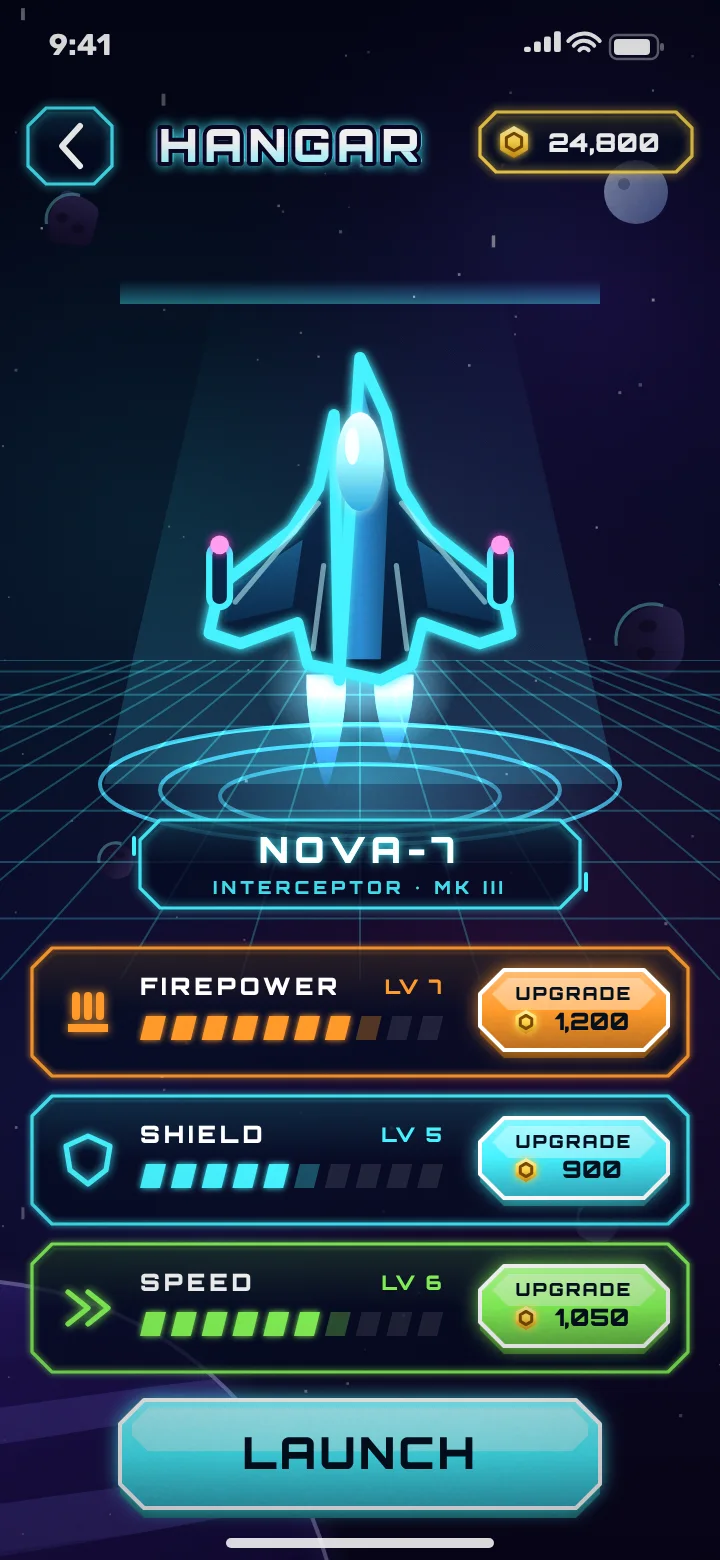
This brief is close to the constraint in our example concept: one ship and a curated set of waves and bosses keep it tight, and extra ships or modes are Advanced. Our scope guide lists a broader boss roster, enemy classes and an upgrade tree among Advanced shooter signals, so the test is reuse. Four bosses on one rig with different patterns are a content task; four bosses with their own art, phases and mechanics are a system.
Questions to answer before you ask for a price
Any studio, including ours, can price a shooter more accurately when the brief answers a few counting questions. Rough answers are fine; the blueprint turns them into firm numbers.
Space shooter pricing questions
- How many ships at launch, and do they play differently or only look different?
- How many enemy behaviors, and which one is new in each sector?
- How many bosses, and do they share one rig or each need their own art and mechanics?
- Which weapons or power-ups exist, and are they picked up in a run or bought between runs?
- Which ship stats can be upgraded, and how many levels each?
- Is there one setting, or does play move to new places (planets, asteroid fields, interiors)?
- One mode, or a second mode such as endless or boss rush?
- Single-player only, or any online feature (leaderboards, co-op, versus)?
- Do you need launch creative and campaign management, and who funds the ad spend?
If most answers are "one" or "a few", the idea is probably Core-sized. If several answers are "several" or "online", expect Advanced or a quote. The game idea quiz runs a short version of the same test.
How package prices compare with studio quotes
Innovecs Games' 2026 estimate puts a simple casual game at $15,000 to $35,000 and a casual game with progression at $30,000 to $150,000. A shooter with sectors and ship upgrades sits in that second band at a studio. The same estimate quotes hourly rates of about $62 to $150 in North America and $25 to $50 in Asia, and notes that user acquisition often costs 30% to 100% of the development budget in competitive categories.
A fixed package reaches a lower number by fixing the shape: one mechanic, one mode, one environment, a production pipeline already set up for it. That is a good trade if your idea fits the shape, and a poor one if the idea depends on things the shape excludes.
Sources: [S18]: Innovecs Games, How Much Does Mobile Game Development Cost in 2026? (opens in a new tab)
When a package fits and when to look elsewhere
- Fits: a short-session arcade shooter you want polished and on both stores, where the fun is dodging, power-ups and boss fights. The space shooter game page shows the example concept and the package it maps to.
- Fits with launch: shooters sell on motion, so most buyers pair the build with Core Game + Launch for 16 video and static creatives and 30 days of campaign management. Ad spend is paid separately to the ad platforms.
- Does not fit: a bullet-hell game with hundreds of hand-authored patterns, a premium campaign with story and voice, or anything online. Those need a custom quote or a specialist studio.
- Simpler still: if you want a one-tap dodge game rather than a shooter, look at hyper-casual formats, which cost less to test.
Once the scope is settled, the next decision is what to put in the first release; what a small mobile shooter should launch with covers the wave plan and low-end phone testing.
Frequently asked questions
How much does it cost to make a space shooter game?
A one-ship, one-mode, one-environment shooter fits the $499 Core Game package, or $1,299 with a 30-day launch. Several maps, an upgrade tree and missions fit Advanced Game + Launch at $2,999.
Can a Core shooter have bosses?
Yes, when they are a small set of pattern-based bosses that reuse the game's bullet and enemy systems. A larger roster with distinct phases and art per boss is an Advanced signal.
What counts as one environment in a space shooter?
One background art family, one camera and scroll direction and one hazard set. Sectors can change wave mixes and color accents inside it.
Is online multiplayer possible?
Online co-op or versus play needs servers, matchmaking and netcode, so it is outside the packages and gets a custom quote.
Does the price include advertising?
No package includes ad spend. Core Game + Launch and Advanced Game + Launch include creative production and 30 days of campaign management, while the media budget is paid through your own ad accounts.
Sources
- [S19] Apple Developer, Enrollment
- [S20] Google Play Console Help, Get started with Play Console
- [S18] Innovecs Games, How Much Does Mobile Game Development Cost in 2026?
Written and reviewed by the DFY Games team. Published ; facts checked . Prices and store rules change: check the linked sources before you rely on a figure.