What you are paying for in a block puzzle
A block puzzle looks small on paper: a grid, a tray of pieces, lines that clear. Most of the work sits in details players feel without noticing. The piece generator has to avoid dealing a hopeless tray in the first minute, pieces have to snap cleanly under a thumb, clear effects have to stay smooth on cheap phones, and the continue offer has to appear at the moment a player actually wants it. That work is the same at $499 or $50,000.
What moves the price is how many systems surround the board. For a buyer, the useful question is which layers you need on launch day: the board alone, challenges and themes, a progression system with levels, and analytics you can act on. Each layer adds design, art, balancing and testing time, and the jump from one to the next is uneven.
Four block puzzle scopes compared
| Scope | What the player gets | Best-fit route | Price |
|---|---|---|---|
| Basic board | One 8x8 or 9x9 board, one placement rule, a three-piece tray, endless score mode, local best score, rewarded continue, remove-ads purchase | Core Game | $499 |
| Board with themes and a daily puzzle | The same board and rule, unlockable block themes, a daily challenge generated on the device from the date, a simple streak calendar | Core Game, when the blueprint confirms it | $499 |
| Either of the above with a launch | The same game plus 16 launch creatives, campaign setup and 30 days of active campaign management | Core Game + Launch | $1,299 plus your ad spend |
| Levels, map and analytics | Classic mode plus a goal-based level mode, a world map, coins and boosters, an analytics event map and crash reporting | Advanced Game + Launch | $2,999 plus your ad spend |
| Live puzzle service | Server-delivered events, accounts, online leaderboards or tournaments, a regular content schedule | Custom quote | Quoted |
The prices are fixed package prices, not estimates. They exclude Apple's $99 yearly developer membership, Google Play's $25 one-time registration, advertising spend and any third-party subscription you choose. Revisions are unlimited until first submission inside the approved blueprint; a new mode added after approval is a scope change with its own quote.
Sources: [S19]: Apple Developer, Enrollment (opens in a new tab)[S20]: Google Play Console Help, Get started with Play Console (opens in a new tab)
The basic board and what Core covers
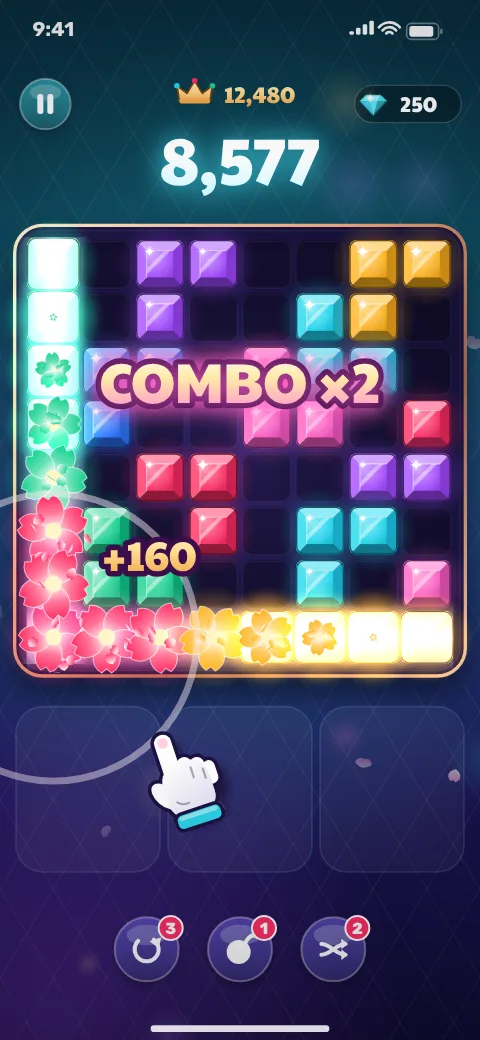
Our example block puzzle concept is built to sit inside Core: one board, one rule and a seeded piece generator. Jewel blocks sit on dark velvet, and every cleared row or column bursts into petals and light. The first tray always contains a piece that clears a line, so the payoff arrives in the first few seconds, and a placement preview shows which lines will clear before the player lets go. You can see the full concept on the block puzzle game page.
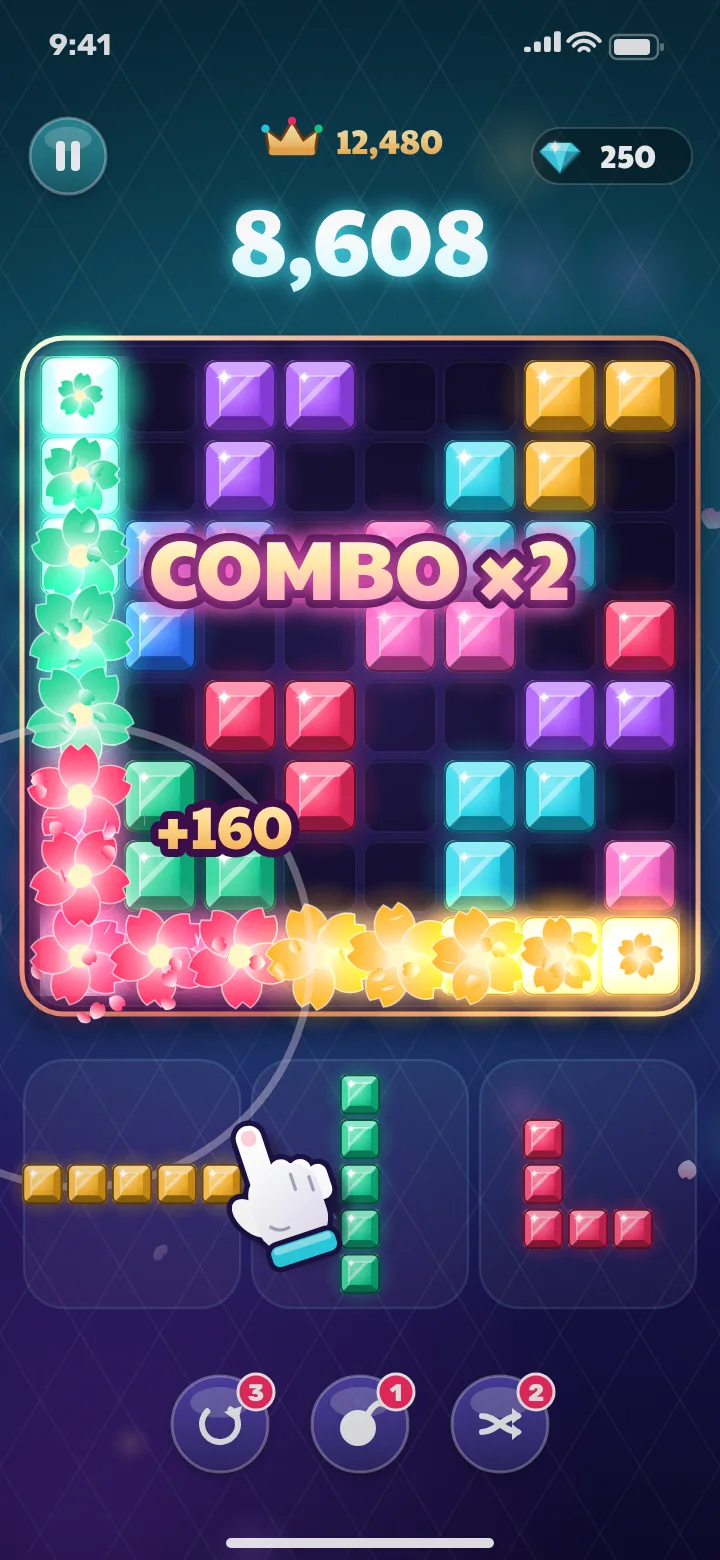
- Board and tray: one grid size, a fixed set of piece shapes, three pieces per tray.
- Rules: full rows and columns clear, simultaneous clears score a combo, the run ends when no piece fits.
- Feel: drag offset so the finger never hides the piece, a landing preview, clear effects, sound and haptics.
- Retention basics: best score, a short first-run hint and local save.
- Revenue: a rewarded continue on a full board, interstitials between runs, a remove-ads purchase and one more simple purchase if it makes sense.
- Release: internal QA, up to 15 invited playtesters, a store kit and one submission and review-response cycle.
Challenges, themes and progression: where the line moves
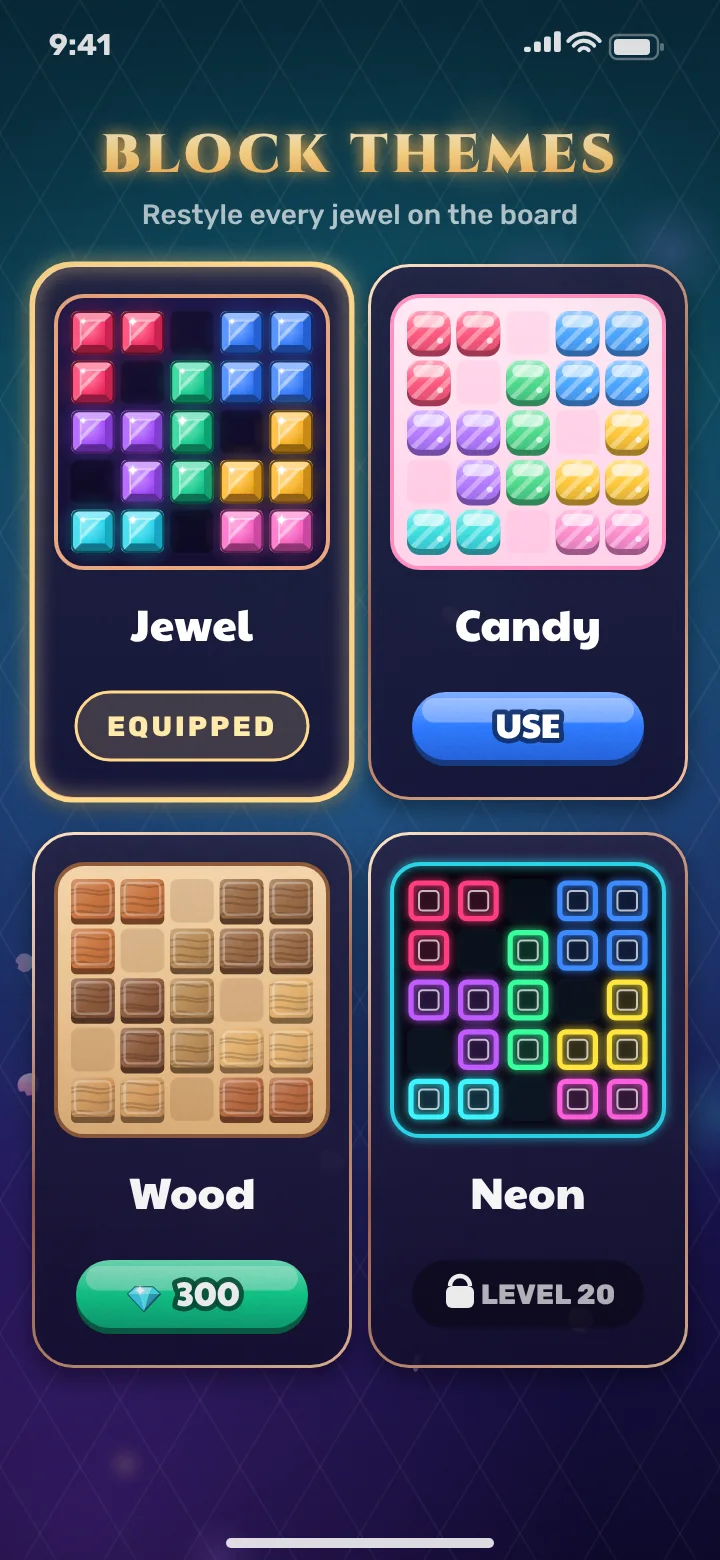
Themes are the cheapest layer when they are reskins. The shapes and rules stay the same and the materials, palette and clear effect change. Our example concept shows jewel, candy, wood and neon versions of one board. Each theme still needs its own art pass, a preview in the picker and a check that colors stay distinguishable on a busy board. Sold as a cosmetic pack, a theme bundle can take one of the two simple in-app purchase slots in Core, next to remove-ads.
Daily challenges come in two sizes. A daily puzzle that uses the same generator with the date as its seed, plus a calendar that marks completed days, reuses the board and stays close to Core; it is part of our example concept. A daily challenge with hand-designed boards, rewards that feed a coin economy, paid streak protection or content pushed from a server is a second system. Our scope guide lists daily challenges, world maps and layered boosters among the signals of an Advanced puzzle build.
Progression is where most block puzzle budgets jump. Best score plus theme unlocks is a simple ladder. A level mode is closer to a second game: every level needs a designed starting board, a goal (clear marked cells, collect gems, reach a score), a piece or move limit and a difficulty check. Add a map to travel along and boosters to buy, and you have the Advanced shape described in the table above.
Analytics at each package level
Core scope does not list an analytics event map. Core Game + Launch adds a pixel and SDK event map so ad campaigns can optimize toward in-game events. Advanced includes an instrumentation workstream: an analytics event map, crash reporting and attribution-ready events where the chosen toolchain allows. If you want to tune difficulty from real play, agree the event names before the build starts, because adding them afterwards means another release.
A starter event list for a block puzzle
- run_start, with the mode and theme
- line_clear, with the number of lines cleared at once
- board_full, with the score and run length at that moment
- continue_offered and continue_accepted
- run_end, with score, duration and whether it was a new best
- daily_complete, with the streak length
- theme_unlocked and purchase_completed
Leave out per-placement events unless someone will read them. They multiply event volume quickly and rarely change a decision.
How this compares with studio pricing
Innovecs Games' 2026 estimate puts a simple casual mobile game at $15,000 to $35,000, a casual game with progression at $30,000 to $150,000 and a puzzle game with light live-ops at $80,000 to $250,000. Its hourly rates run about $62 to $150 in North America, $50 to $100 in Eastern Europe and $25 to $50 in Asia. These are one studio's published figures, useful as a market reference.
A fixed package costs less because it limits the game to one mechanic, one mode and one main environment, and the studio reuses a production pipeline built for that shape. A studio quote prices open-ended work. If you need a live-ops team shipping new events every month, a studio retainer is the honest route. The same estimate also notes that player acquisition often costs 30% to 100% of the development budget in competitive categories, so plan money for launch whichever route you pick.
Block puzzles sit between classic puzzle games and hyper-casual games: short sessions, one rule, a broad audience. If you are still choosing a format, the puzzle games overview compares the other puzzle types we build.
Sources: [S18]: Innovecs Games, How Much Does Mobile Game Development Cost in 2026? (opens in a new tab)
When a fixed package fits and when it does not
- It fits when you want one polished board and rule, a clear identity and a release on both stores without hiring a team.
- It fits when you have an audience (a channel, a brand, a community) and want a game that carries your look.
- It does not fit when the plan depends on weekly live events, online tournaments or accounts from day one. That needs a custom quote or a studio retainer.
- It does not fit when the brief is a near copy of a famous block game. Rules are shared across the genre, but names, art and layout are not; see how to write an original block puzzle brief.
- If you are a developer who mainly wants to learn, a paid engine template is cheaper than any service and teaches you more.
When the Core scope matches your idea, you can start a Core build directly; if you are unsure where your idea lands, the blueprint at kickoff settles it, and you can trim, upgrade or take a full refund.
Frequently asked questions
How much does it cost to make a block puzzle game?
A one-board, one-rule block puzzle fits the $499 Core Game package. A version with a level mode, a map, an economy and analytics fits Advanced Game + Launch at $2,999, and a studio build of a simple casual game typically runs $15,000 to $35,000 by one 2026 estimate.
Can a block puzzle with themes and a daily challenge stay at $499?
Usually, if the themes are reskins of the same board and the daily puzzle is generated on the device from the date. Hand-designed daily boards, reward economies or server-delivered content move it toward Advanced.
Is analytics included in Core Game?
Core scope does not list an analytics event map. Core Game + Launch adds a pixel and SDK event map for campaigns, and Advanced includes analytics events, crash reporting and attribution-ready events where the toolchain allows.
What costs are outside the package price?
Apple's $99 yearly developer fee, Google Play's $25 one-time fee, advertising spend and any third-party services you choose. Store commission on in-app purchases is also taken by Apple and Google.
Do I own the block puzzle after it is built?
After full payment you receive the game files and the original assets made for the project. Third-party software, fonts, SDKs and stock assets keep their own licenses.
Sources
- [S18] Innovecs Games, How Much Does Mobile Game Development Cost in 2026?
- [S19] Apple Developer, Enrollment
- [S20] Google Play Console Help, Get started with Play Console
Written and reviewed by the DFY Games team. Published ; facts checked . Prices and store rules change: check the linked sources before you rely on a figure.