What an endless runner costs at each scope
Runners look simple and are, in system terms: one character moving forward, a handful of inputs, obstacles arriving faster over time. Almost all of the cost sits in three choices: how many environments, how many obstacle types and how much the characters do.
| Scope | Environments | Obstacles and characters | Price |
|---|---|---|---|
| Core Game | One environment theme, endless score mode | A compact obstacle set, cosmetic skins, rewarded revive, local high score | $499 |
| Core Game + Launch | Same | Same, plus 16 launch creatives and 30 days of campaign management | $1,299 plus ad spend |
| Advanced Game + Launch | Multiple biomes or worlds | Characters with abilities, missions, upgrade tree, collectibles, events | $2,999 plus ad spend |
| Custom quote | Large or open environments | Realtime races against other players, licensed characters | Quoted |
The endless runner game page lists the full package contents. Timing follows the package: a submission-ready Core build is targeted in 10 business days; Advanced reaches a first playable in 10 business days and normally completes within 30 days.
The three levers that set the price
| Addition | Work it creates | Why it costs more than it looks |
|---|---|---|
| Another environment | New track pieces, backdrop layers, lighting, obstacle reskins, music, readability pass | Every obstacle must stay readable against the new background, so QA repeats per world |
| Another obstacle type | Art, hit box, warning cue, counter-move, placement rules in the spawner | Each new type has to be tested against every existing one it can appear next to |
| A cosmetic skin | Recolor or new sprite set, trail effect, shop entry | Cheap; no gameplay change |
| A character with an ability | Animation set, ability logic, balance against obstacles, UI to explain it | An ability changes what is possible, so difficulty tuning starts again |
The obstacle row is the one buyers underestimate. With four obstacle types there are a few dozen pairings the spawner can produce; with eight there are several times as many, and a single unfair pairing (a drone directly after a gap, with no time to land) is enough to make players quit. Keeping the set compact is how a Core runner stays fair.
Three runner configurations compared
| A: one world | B: one world, deeper | C: several worlds | |
|---|---|---|---|
| Environments | 1 theme with a weather or night variant | 1 theme | 3 biomes |
| Obstacle types | A compact set, e.g. 4-5 | A compact set | A broader set per biome |
| Characters | Cosmetic skins and trails | Cosmetic skins | Characters with abilities |
| Meta progression | High score, daily best, skin unlocks | Missions and an upgrade tree | Missions, upgrades, collectibles |
| Monetization | Rewarded revive, skins, results interstitial | Plus deeper IAP economy | Plus offers and bundles |
| Package | Core ($499) or Core + Launch ($1,299) | Advanced + Launch ($2,999) | Advanced + Launch, or quote if very large |
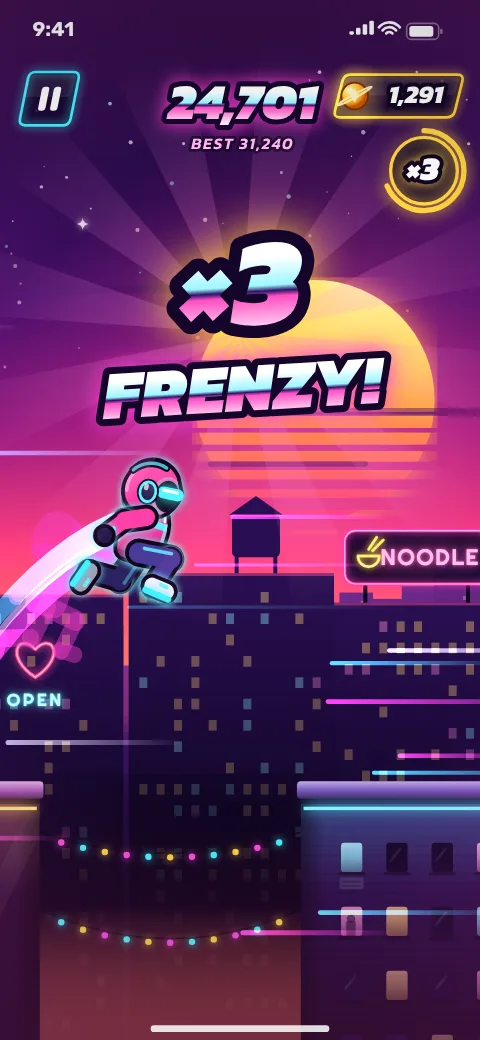
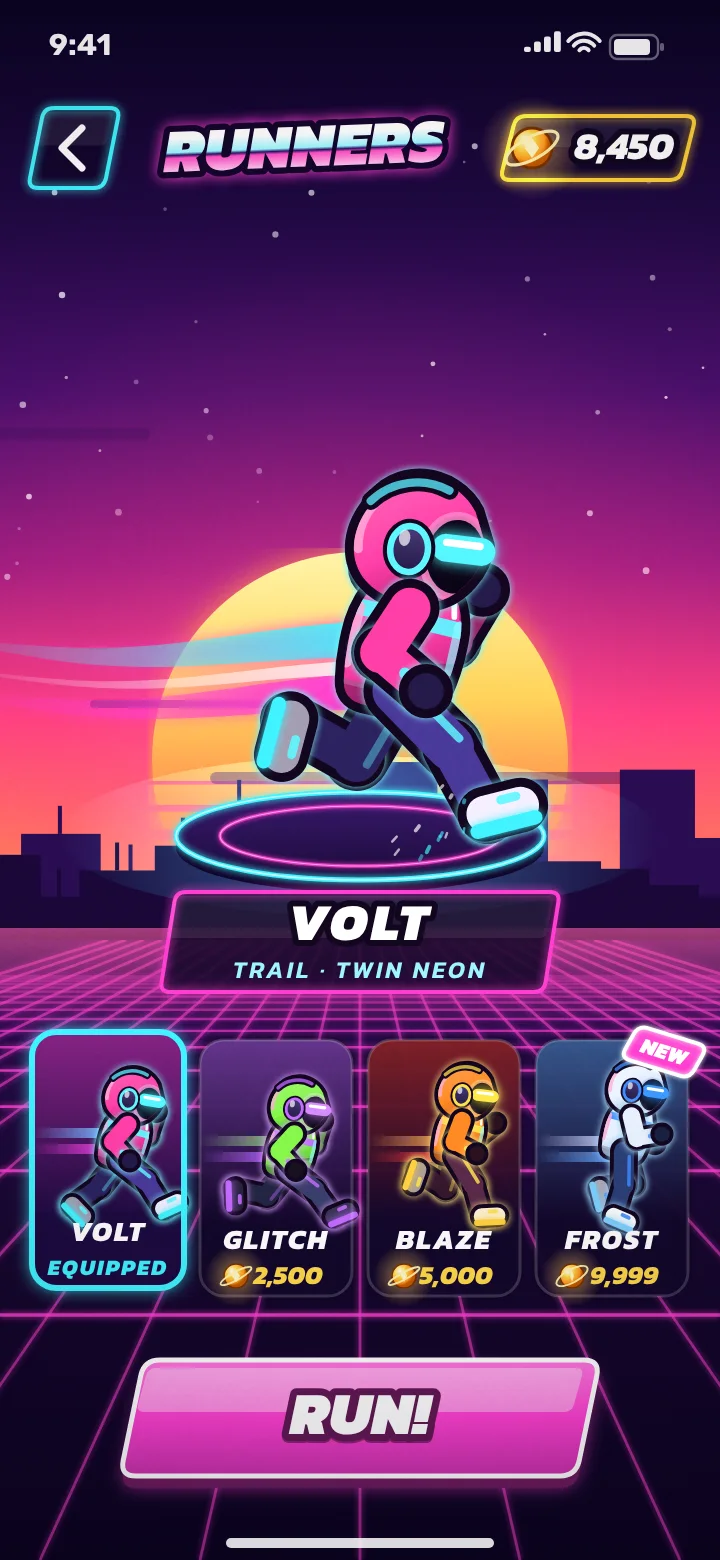
Configuration A is our example endless runner concept: neon rooftops, one endless mode, near-miss multipliers and skins that change the light trail. A rain variant of the same city adds atmosphere without counting as a second world, because the track pieces and obstacles are shared. B is the right step when retention matters more than variety, and C is for a brief built around exploring places.
Example: a playable one-world first release
Configuration A is easier to judge when you can see the whole first release written out. This is the scope of our example endless runner concept, broken into the parts a buyer can actually play. The counts are illustrative; the blueprint sets the real numbers for your game.
| Part | In the first release | Left for a later version |
|---|---|---|
| World | One neon rooftop city, plus a rainy-night lighting variant that reuses the same track pieces | A second biome with its own track pieces and obstacle art |
| Track content | A pool of short hand-built chunks, mixed in a rule-checked order so runs do not repeat | Themed chunk sets per world |
| Obstacle set | Four types (gap, drone, laser fence, vent burst), each with one counter-move and a warning cue | New obstacle types that need new counter-moves |
| Controls | One thumb: tap to jump, swipe down to slide or fast-drop, buffered input near landing | Hold-to-jump, lane switching or tilt controls |
| Characters | One runner with cosmetic skins and light-trail colors | Characters with abilities that change what is possible |
| Meta loop | Run, results, coins, skin unlocks, local high score and daily best | Missions, an upgrade tree, collectibles, online leaderboards |
| Monetization | One rewarded revive per run, cosmetic skins as purchases, interstitial after the results screen | Bundles, offers and a soft-currency economy |
Everything in the middle column is playable at the end of a Core build: a new player can start a run, learn all four obstacles, die, revive once, see a result and buy or unlock a skin. That loop is enough to show whether the controls and pacing hold attention, which is the question a first release should answer before more worlds are paid for.
How runner content is built, and why it matters for price
Most endless runners are assembled from short hand-built track pieces, often called chunks, that the game strings together in a random but rule-checked order. Each chunk is a few seconds of track with a fixed layout of obstacles and coins. The number of chunks decides how varied a run feels; the number of environments decides how many times that set has to be drawn.
| Content | Grows with | Cost effect |
|---|---|---|
| Track chunks | Variety you want within one world | Moderate; each chunk is designed once and reused endlessly |
| Obstacle types | Number of distinct moves the player must learn | High; each new type has to be tested against the others |
| Environment art | Number of worlds or biomes | High; every chunk and obstacle needs a matching look |
| Characters | Cosmetic skins versus ability characters | Low for skins, high for abilities |
| Difficulty rules | How speed and chunk selection change over a run | Moderate; tuned in playtesting |
This is why a rain-at-night variant of one city is cheap and a desert world is not. The variant reuses every chunk and obstacle with new lighting, while the desert needs its own chunks, obstacle art and readability checks.
Studio ranges for comparison
Innovecs Games puts a hyper-casual playable MVP at $4,000 to $12,000, a simple casual game at $15,000 to $35,000 and a casual game with progression at $30,000 to $150,000 in 2026. A polished runner with missions and multiple worlds sits in that last band at most studios. The same source puts user acquisition at 30% to 100% of the development budget, so plan the ad budget alongside the build.
Outside the build you also pay $99 a year for the Apple Developer Program and $25 once for Google Play, plus any ad spend.
Sources: [S18]: Innovecs Games, How Much Does Mobile Game Development Cost in 2026? (opens in a new tab)[S19]: Apple Developer, Enrollment (opens in a new tab)[S20]: Google Play Console Help, Get started with Play Console (opens in a new tab)
When to choose which
- Choose Core when the hook is the feel of one run: speed, near misses, a clean restart.
- Choose Core + Launch when you will spend on ads anyway and want creatives built from the same assets.
- Choose Advanced when your idea only works with several worlds, abilities or a mission structure.
- Consider a hyper-casual prototype elsewhere if all you need is a rough test build for internal ad testing and you do not plan to publish it.
Before you commit to any tier, write down the controls and obstacles. The runner brief guide has a blueprint format for exactly that, and the hyper-casual games page covers neighbouring one-touch genres.
Frequently asked questions
How much does an endless runner game cost to develop?
A one-environment runner costs $499 as a DFY Core build or $1,299 with a launch campaign. Studio estimates for a simple casual game run $15,000 to $35,000.
Does adding a new world double the cost?
It adds a full art set and repeats readability and QA work for every obstacle, which is why multiple worlds sit in Advanced.
Are skins included in the Core package?
Yes, cosmetic skins are included. Characters with abilities that change gameplay are an Advanced feature.
Can a runner have online leaderboards at $499?
No. Core uses a local high score; leaderboards and async competition need a backend and are scoped in Advanced.
How long does an endless runner take to build?
Core targets a submission-ready build in 10 business days after blueprint approval. Store testing and review happen afterward and are controlled by Apple and Google.
Sources
- [S18] Innovecs Games, How Much Does Mobile Game Development Cost in 2026?
- [S19] Apple Developer, Enrollment
- [S20] Google Play Console Help, Get started with Play Console
Written and reviewed by the DFY Games team. Published ; facts checked . Prices and store rules change: check the linked sources before you rely on a figure.