One-track versus multi-track: two briefs compared
This guide covers the budget for an arcade racing game: original cars, one simplified handling model and short races. It does not price a simulation racer with realistic physics, licensed cars or real circuits, which is a different project with a different budget. If you have not yet decided tracks, cars and handling, how to scope and brief an arcade racing game walks through those decisions first.
Racing prices move with content more than with features. The handling model is built once; every track and car after that is something to design, dress, tune and test. These two briefs are written around the same drift-and-boost idea, so the only difference is how much racing they contain.
| Brief element | One-track brief | Multi-track brief |
|---|---|---|
| Tracks | One top-down track | Several tracks across a few themes |
| Vehicles | One car, with paint jobs as unlocks | Several cars with speed, grip and boost upgrades |
| Modes | Time trial or a basic opponent race | Cup races plus time trial |
| Opponents | Best-lap ghost or simple AI | AI rivals tuned per track |
| Progression | Best lap, coins, paint | Cups, car unlocks, upgrade levels |
| Revenue | Rewarded double coins, remove-ads, one simple purchase | Deeper economy with offers and more products |
| Analytics | Not in Core scope; campaign events with the launch add-on | Event map, crash reporting, attribution-ready events |
| Launch | Optional: Core Game + Launch adds 16 creatives and 30 days of management | Included: 16 creatives and 30 days of management |
| Timing | Submission-ready build targeted in 10 business days | First playable in 10 business days; full build within 30 days |
| Route and price | Core Game, $499 ($1,299 with launch) | Advanced Game + Launch, $2,999 |
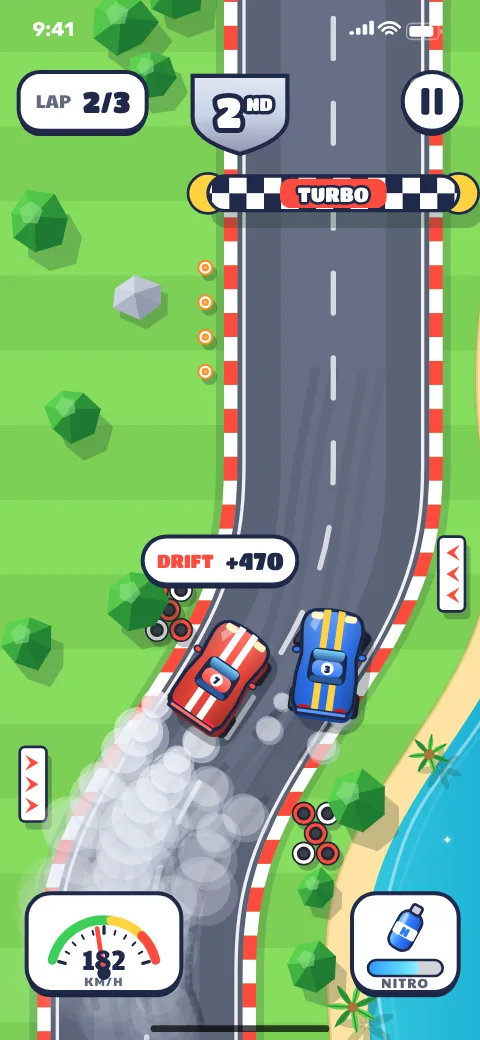
Our scope guide defines Core racing as one track, one vehicle, one time-trial or basic opponent mode, simple controls and a local best time. The example concept on the arcade racing game page shows three track themes and a garage; that set sits at the line between the two briefs, and the blueprint decides which side it lands on.
Why each extra track and car costs more than it looks
Content in a racer multiplies. Three tracks and six cars make 18 combinations, and each one needs a lap that feels fair: a fast car should not break a tight track, and a slow car should still be able to win a cup. Add AI rivals and each track also needs a racing line and rival speeds that feel beatable without looking scripted.
- Layout design and collision for every track, plus art dressing for every theme.
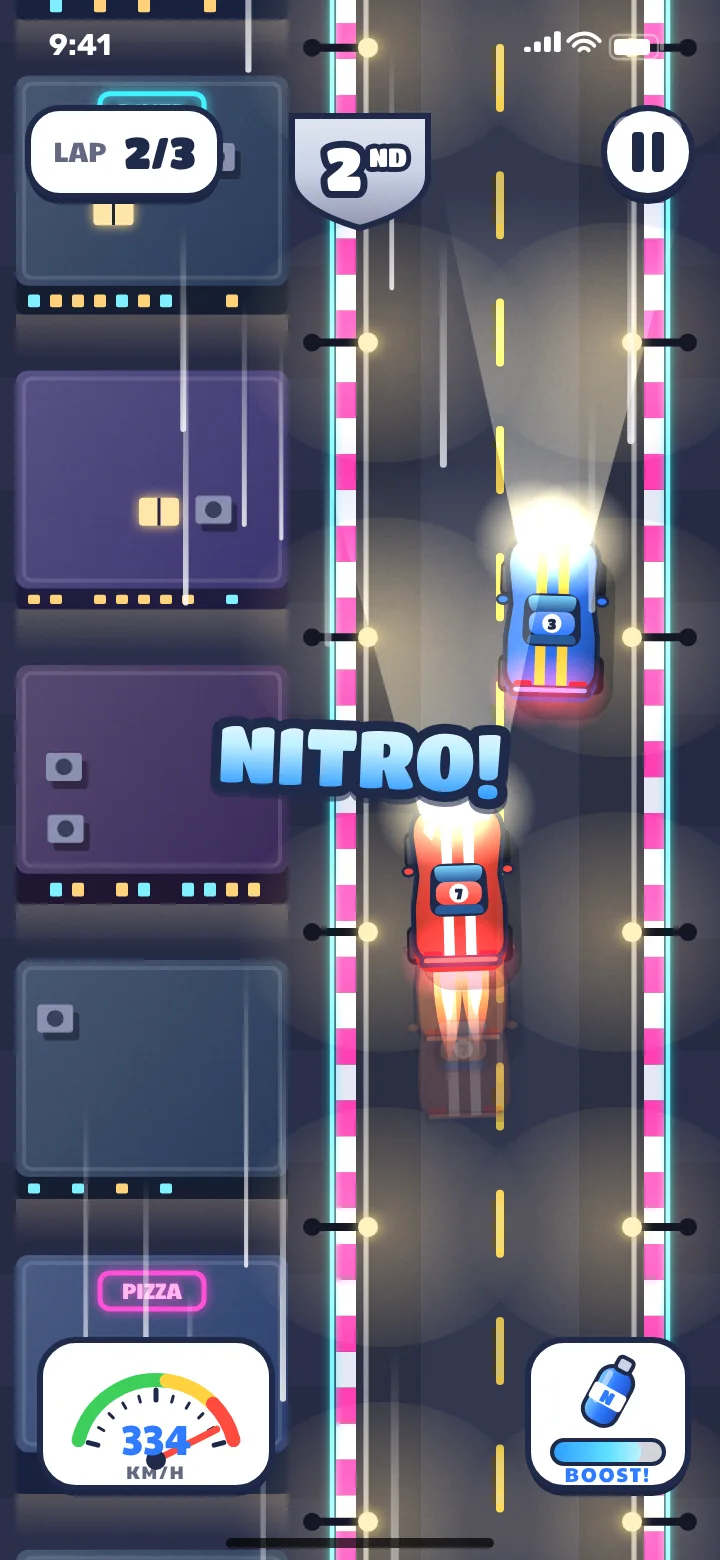
- Performance checks per track: a night city full of lights costs more to draw than a desert.
- Balancing every car on every track, repeated whenever an upgrade level changes.
- Store and ad assets that show the range, which the launch package then has to cover.
What the prices assume, and what they leave out
- Original cars and tracks. Real car brands and real circuits are licensed IP and outside the packages.
- Single-player with local save. Online racing, accounts and cloud leaderboards are a custom quote.
- Developer accounts in your name: Apple charges $99 a year and Google Play $25 once.
- Apple and Google take a commission on in-app purchases. Both offer a 15% rate to smaller developers: Apple through its Small Business Program for developers with up to $1 million in yearly proceeds, Google on the first $1 million of yearly earnings, with terms varying by market.
- Ad spend is paid to the ad platforms and is not part of any package price.
- Revisions are unlimited until first submission inside the approved blueprint. A new track or car after approval is a scope change.
Sources: [S19]: Apple Developer, Enrollment (opens in a new tab)[S20]: Google Play Console Help, Get started with Play Console (opens in a new tab)[S21]: Apple Developer, App Store Small Business Program (opens in a new tab)[S22]: Google Play Console Help, Service fees (opens in a new tab)
What handling evidence to ask for at the playable checkpoint
The playable checkpoint is where a racing budget is protected or wasted. In a Core build the playable loop arrives in days 2-3 with the first feedback window; in Advanced, the polished first playable is targeted at day 10. Either way, handling is cheapest to change here and most expensive to change after art and tracks are built around it. Ask for evidence you can check yourself:
Handling evidence for the playable checkpoint
- A build you can install on your own phone, not only a video.
- A screen recording on a lower-end Android phone, with the frame counter visible on the busiest part of the track.
- The first corner taught without text: does holding start a drift and releasing fire a boost?
- Wall contact: the car slides along a barrier and loses some speed instead of stopping dead.
- Camera at top speed and during a boost: the road ahead stays readable.
- A tuning sheet listing the adjustable values (steering rate, drift angle, grip recovery, boost strength and duration).
- Internal lap times from several runs, so you can see whether a clean lap is repeatable.
- If AI rivals are in scope, a race where you deliberately fall behind, to see how they react.
| What you might say | What to ask for instead |
|---|---|
| It feels floaty | Faster grip recovery after a drift, and less camera lag |
| It's too hard to steer | Lower steering rate at top speed, or a wider first corner |
| The boost is boring | A stronger, shorter boost with a clearer visual and sound cue |
| Crashing is annoying | Walls that redirect the car along the barrier with a smaller speed loss |
| I can't see where I'm going | Camera pulled further back or tilted forward at high speed |
How studio quotes compare
Innovecs Games' 2026 estimate puts a simple casual game at $15,000 to $35,000 and a casual game with progression at $30,000 to $150,000; a multi-track racer with cups and upgrades belongs in the second band at a studio. Its quoted hourly rates are about $62 to $150 in North America, $50 to $100 in Eastern Europe and $25 to $50 in Asia, and it notes that player acquisition often costs 30% to 100% of the development budget in competitive categories.
A studio quote is the better route when you need licensed cars, a realistic simulation or online racing, or a team to keep adding tracks every month. For an original arcade racer with one handling model, a package fixes the price before work starts. The comparison of game build options covers freelancers, studios and packages side by side.
Sources: [S18]: Innovecs Games, How Much Does Mobile Game Development Cost in 2026? (opens in a new tab)
Choosing between the two briefs
If the handling is unproven, start with one track. You learn whether the drift and boost are fun for $499, and more tracks can follow as a quoted update. Choose the multi-track brief when your audience expects progression from day one, for example a car community or a brand with a racing angle, and you are ready for a build of up to 30 days. The guide on how to scope and brief an arcade racing game turns these choices into a one-page brief; when the brief is settled, you can begin the build.
Frequently asked questions
How much does an arcade racing game cost?
A one-track, one-car arcade racer fits the $499 Core Game package, or $1,299 with a 30-day launch. A multi-track racer with several cars, AI rivals and cups fits Advanced Game + Launch at $2,999.
Why do more tracks cost so much more?
Every track needs design, art, collision and testing with every car, and AI rivals need a racing line per track. Content combinations multiply the tuning work.
When can I try the handling?
In a Core build, the playable loop arrives in days 2-3 for feedback. In Advanced, the polished first playable is targeted at day 10.
What should I check in the first playable?
Install it on your own phone and check drift entry and exit, wall contact, camera at top speed and frame rate on a lower-end device, and ask for the tuning sheet.
Is online racing included?
No. Online racing needs servers, matchmaking and netcode, so it gets a custom quote.
Sources
- [S18] Innovecs Games, How Much Does Mobile Game Development Cost in 2026?
- [S19] Apple Developer, Enrollment
- [S20] Google Play Console Help, Get started with Play Console
- [S21] Apple Developer, App Store Small Business Program
- [S22] Google Play Console Help, Service fees
Written and reviewed by the DFY Games team. Published ; facts checked . Prices and store rules change: check the linked sources before you rely on a figure.