Arcade versus simulation: decide this first
This guide is about writing the scope of an arcade racing game before anyone quotes it: which decisions to make, in what order, and how to put them on one page. For package prices and the budget choices that move a racer between tiers, read what an arcade racing game costs and which choices change the budget.
Every other scoping decision depends on which kind of racer you are making. Arcade racers chase a feeling: speed, a satisfying drift, a boost at the right moment. Simulation racers chase accuracy: tire grip, weight transfer, gear ratios. On a phone with a small budget, arcade is almost always the right call.
| Aspect | Arcade racer | Simulation racer |
|---|---|---|
| Goal | Feel fast and forgiving | Behave like real cars |
| Input | One or two touches: steer, or hold to drift | Steering, throttle, brake, often gears and assists |
| Physics | Simplified and tuned by hand for feel | Detailed models of tires, suspension and weight |
| Vehicles | Differ by stats and look | Differ by measured data; real models need brand licenses |
| Tracks | Short, readable, often stylized | Longer, realistic, sometimes based on real circuits |
| Tuning effort | Concentrated on one handling model | Per car, per track, per condition |
| Session | One to three minutes | Often longer |
| Fit for a package build | Good, if scoped to one handling model | Poor; needs a custom quote or a specialist studio |
Real car makes, models and logos are licensed intellectual property, and licensed IP is outside every DFY package. Original cars avoid the licensing cost and the approval process that comes with it.
Handling is most of the game
In an arcade racer, handling is what players remember and what ads show, so it should be the first thing you define and the first thing you test. Common mobile handling models are auto-accelerate with tap-to-steer, lane switching, tilt steering and hold-to-drift. Pick one. Each extra scheme adds its own round of tuning and testing.
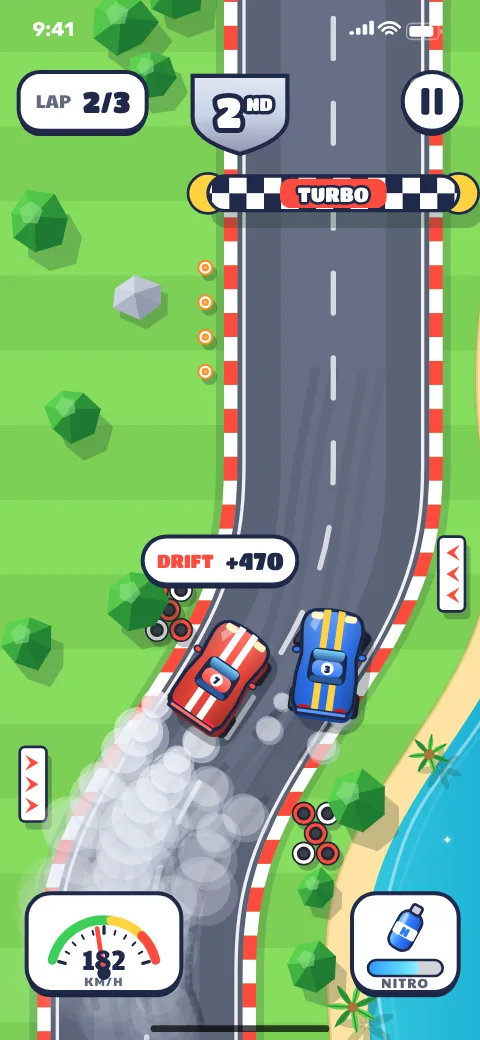
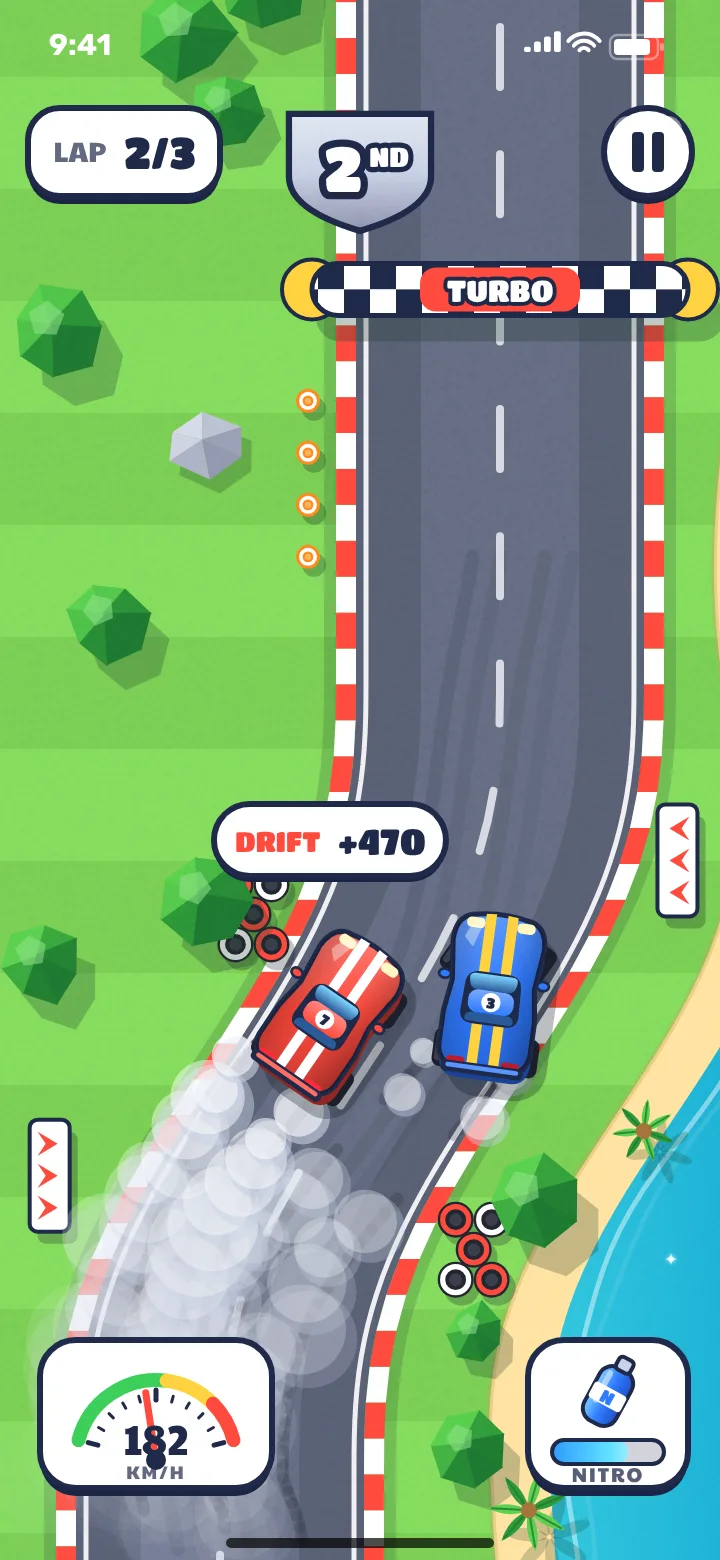
Our example arcade racing concept reduces racing to one input: hold to drift, release to boost. A wide first corner teaches the drift, and releasing it fires the first boost. The drift meter sits at the edge of the screen so players never look away from the road. That single input is why the concept can stay near Core.
- Steering rate: how fast the car turns at low and high speed.
- Drift entry and exit: how sharply the car swings out and how it recovers grip.
- Boost: how strong it is, how long it lasts and how drifting fills it.
- Wall contact: the car should slide along walls and lose some speed, not stop dead.
- Camera: how far it trails the car and how it reacts to boosts.
Tracks: how many and how they are built
Each track costs a layout, art dressing, collision, a racing line for any AI rivals and its own round of lap testing. A theme change is cheaper than a new layout: the same road with desert, city-night or snow art costs art time, while a new road shape also costs design and tuning. Mirrored or reversed versions of a layout are the cheapest extra content.
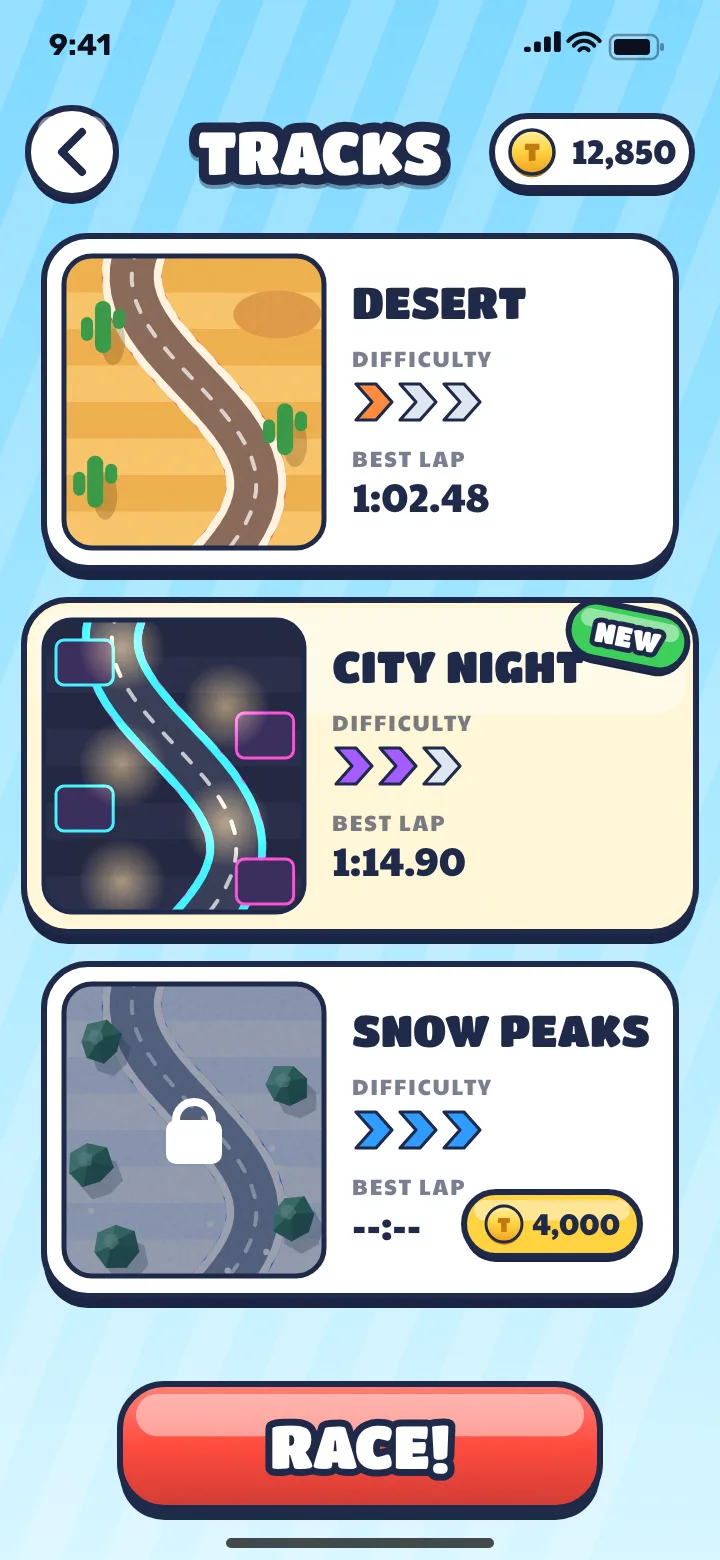
Our example concept's track select shows three themes: desert, city night and a locked snow track. Our scope guide puts multiple tracks among the Advanced racing signals, with Core defined as one track and one vehicle. A three-theme set like the concept's sits at the boundary; the written blueprint decides whether it is one layout with themed variants inside Core or a multi-track Advanced build.
Vehicles: new stats or new handling
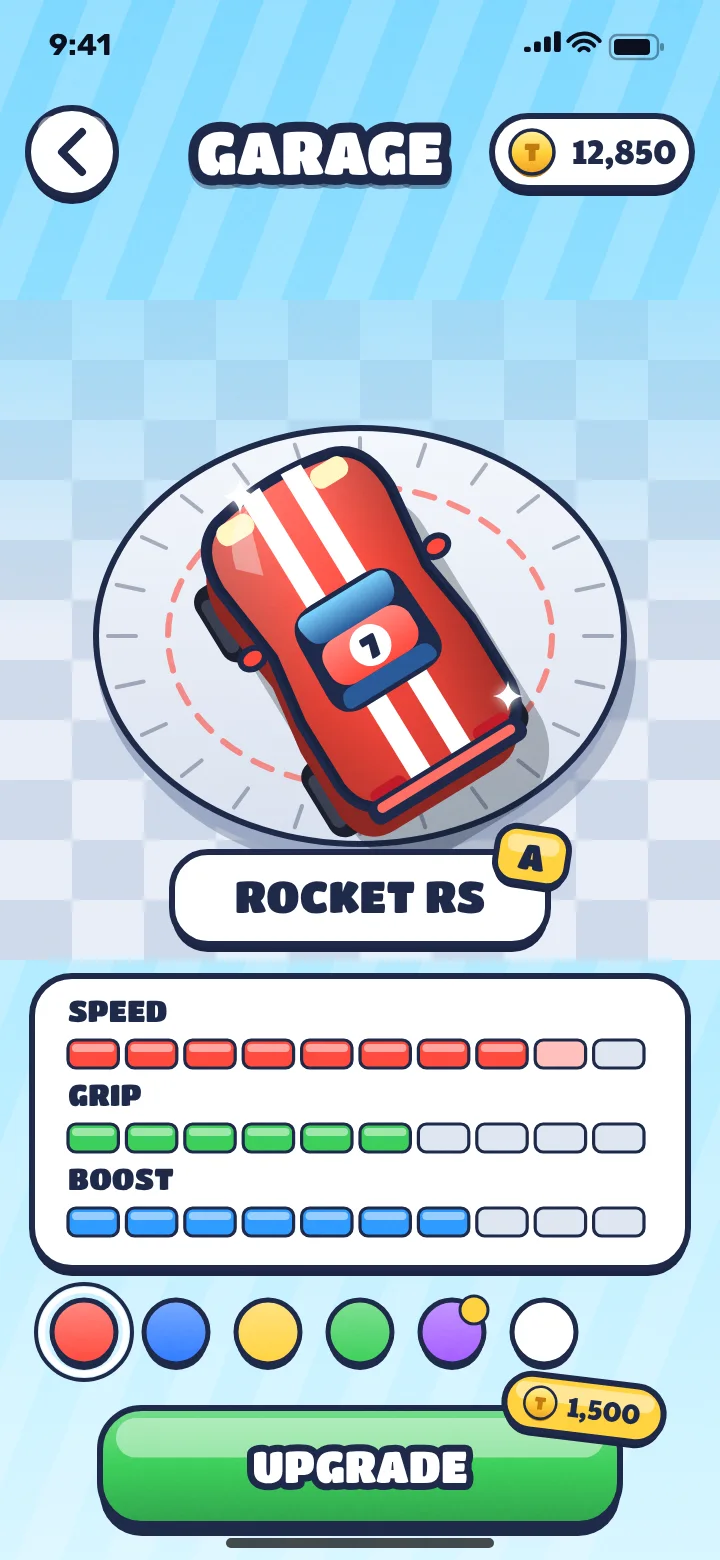
Cars that differ only in paint and stats (speed, grip, boost) reuse one handling model and are mostly an art and balancing task. Vehicles that handle differently, such as trucks, motorbikes or hovercraft, each need their own physics tuning, and every one multiplies the track testing. Paint jobs are the cheapest unlocks of all and make a natural cosmetic purchase.
Opponents and race modes
- Time trial against your best lap is the cheapest mode. A ghost car replaying your best lap adds a visible rival from local data.
- Basic AI opponents follow a racing line with some variation. They fit Core when kept simple.
- AI rivals that block, overtake and adjust their pace to the player (often called rubber-banding) need careful tuning to feel fair, and with cup progression they are an Advanced signal.
- Online racing needs servers, matchmaking and lag handling. It is outside the packages and gets a custom quote.
A scoped example: one drift racer written as a brief
Once the handling, tracks, vehicles and opponents are decided, the scope should fit in one paragraph. This is the drift racer from our example concept written the way a buyer could send it, with the decisions stated and the open questions named.
Each line in that brief answers a question a studio would otherwise have to guess. The later list matters as much as the rest: it shows what you expect to add if the handling works, so the first build can leave room for it without paying for it now.
A scoping checklist for an arcade racer
Answer these before you brief a studio
- Arcade or simulation, and why that suits your players.
- The one input players use, described in a sentence (for example, hold to drift and release to boost).
- Camera: top-down, behind the car or side-on.
- Number of track layouts, and how many themed variants of each.
- Number of vehicles, and whether any handle differently from the rest.
- Race modes: time trial, ghost, AI rivals, cups.
- What players unlock and what they can buy: cars, paint, boosts, remove-ads.
- Whether anything is online. If it is, expect a custom quote.
- Whether any real brands, cars or circuits appear. If they do, budget for licenses outside the build.
A brief that answers these in a page is enough to classify the idea as Core, Advanced or custom before any money changes hands. The mobile game brief template adds audience, monetization and launch questions around it.
Turning the scope into a build
The arcade racing game page shows the full example concept and the package it maps to. For prices on one-track and multi-track briefs, and what handling evidence to ask for at the playable checkpoint, read how much an arcade racing game costs. Lane-switching endless racers are closer to hyper-casual games and scope differently. If you are unsure which shape your idea is, the game idea quiz gives a quick read.
Frequently asked questions
What is the difference between an arcade and a simulation racing game?
Arcade racers use simplified, hand-tuned handling for speed and fun; simulation racers model real car physics. Arcade suits mobile and small budgets far better.
How many tracks can a Core racing game have?
Our scope guide defines Core racing as one track and one vehicle. Themed variants of one layout may fit if the blueprint confirms it; multiple distinct tracks are an Advanced signal.
Can I use real car brands?
Real makes, models and logos are licensed IP, which no DFY package includes. Original cars avoid that cost.
Are AI opponents included in Core?
A time trial or a basic opponent mode fits Core. AI rivals with cup progression and multiple race conditions fit Advanced.
Can the racing game be online?
Online racing needs servers and netcode, so it gets a custom quote outside the packages.
Written and reviewed by the DFY Games team. Published ; facts checked . Prices and store rules change: check the linked sources before you rely on a figure.