Who supplies the words: the four routes
In a commissioned word or trivia game, the content is as much of the product as the code. The blueprint should name the source of every list and question set before the build starts, because the source decides the license, the QA work and who can change it later. This guide covers sources, rights and QA; for how each content choice affects the budget, see word game cost and content licensing choices.
| Source | Who owns it | License obligations | QA effort | Updates |
|---|---|---|---|---|
| Open word list (for example SCOWL) | The list's authors | Permissive; SCOWL allows commercial use if its copyright and permission notice is kept in supporting documentation | Filter offensive words, pick a spelling variant | Re-import when you choose |
| Licensed dictionary | The publisher | Whatever the license says about apps, attribution and term | Usually cleaner, still filter answers | Depends on the license |
| Open trivia database (for example Open Trivia DB) | Its contributors | Open Trivia DB's API data is under CC BY-SA 4.0: attribution and share-alike apply | Fact-check every question you use | Pull new questions, check them again |
| Written for your game (by you or the studio) | You, after full payment | None beyond your contract | Writing, fact-checking, proofreading | You decide |
Share-alike licenses deserve a careful read. They generally require you to credit the source and to release adaptations of the licensed material under the same license, which can matter if you want to sell or protect your question bank. Have a lawyer check how a license applies to your plans before you build a business on it.
Ownership of the content
At DFY Games, after full payment you receive the game files and the original assets made for the project. Word lists, clues and trivia questions written specifically for your game are part of that. Third-party lists, dictionaries and databases keep their original license terms; you receive the right to use them only as far as their license allows. The ownership guide covers the same split for code and art.
If you supply the content yourself, for example a brand's own glossary or a quiz you already run, you keep owning it and you are responsible for having the rights to it. Say so in the brief so it is listed as client-supplied in the blueprint.
Profanity and sensitive word filtering
Large open word lists include slurs, crude words and words that are fine in one country and offensive in another. A word game has two places where that matters, and they need different rules.
- Answer list: no offensive words at all. These are the words the game puts in front of players and in your store screenshots.
- Accepted list: a judgment call. Many games quietly accept a valid but crude word without celebrating it; others block it. Decide and write the rule down.
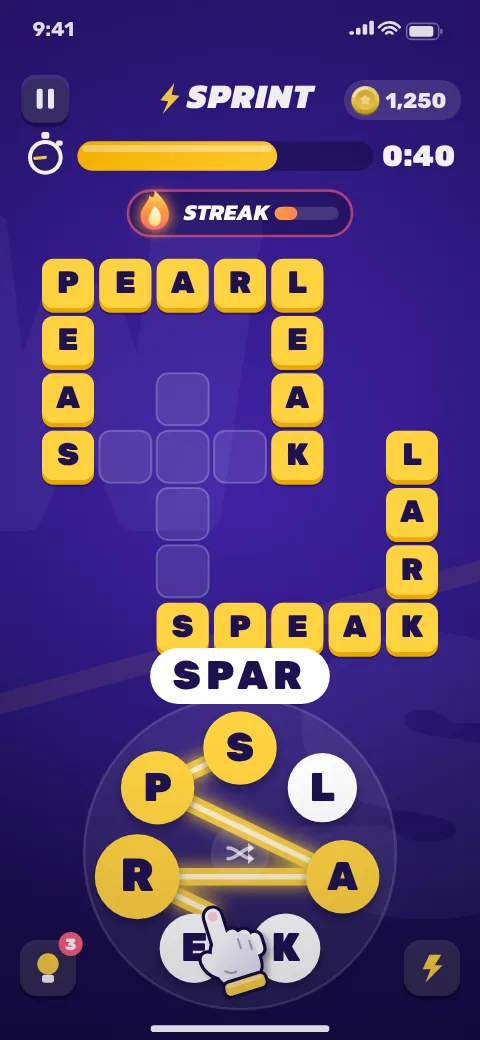
- Generated boards: if letters are randomly drawn, check that the board itself cannot spell something offensive in a highlighted path.
- Audience: if children are part of your audience, Google Play's Families policies add content, data and advertising obligations, and the lists need a stricter pass.
No filter list is perfect, so the QA checklist below includes a human read of every answer word. For a bank of a few thousand answers that is a few hours of work and it is worth every minute.
Sources: [S12]: Google Play, Families Policies (opens in a new tab)
Trivia fact-checking
Trivia errors are the ones players screenshot. Most come from a handful of patterns, and each has a simple fix.
| Problem | Example pattern | Fix |
|---|---|---|
| Facts that expire | "Who is the current champion?" | Avoid "current" and "latest", or tag the question with a review date |
| More than one right answer | A question whose wrong options are also partly true | Have a second person try to argue for each wrong option |
| Unsourced claims | A popular fact that is a myth | Two independent sources per answer, recorded with the question |
| Spelling and variants | US and UK spellings, accents, abbreviations | List accepted variants for typed answers |
| Regional knowledge | Questions only one country can answer | Tag questions by region, or keep categories broadly known |
Content-source and QA checklist
Before content goes into the build
- Every list and question set has a named source and a saved copy of its license
- Attribution or notice requirements are listed, with where they will appear in the app
- Separate accepted-words and answer-words lists exist
- One spelling standard is chosen (for example US English), and variants are handled on purpose
- Every answer word has been read by a person for offensive or awkward meanings
- Every trivia answer has two recorded sources
- Time-sensitive questions are removed or tagged with a review date
- Each category has enough rounds for the agreed content bank
- Content written for the game is marked as commissioned so ownership is clear
- A named person approves the final bank before submission
Updating content after launch
In a Core build the content bank ships offline inside the app, as in our example word game concept. That keeps the game fast, playable without a connection and free of servers. It also means new words or questions arrive through an app update, which goes through store review each time.
Content packs and cloud content delivery are listed under Advanced, and a full content backend with an editing tool is custom work. Ongoing content is not included in any package, so decide who will write and check new content: you, the studio on a separate quote, or a freelance writer working to the checklist above. The maintenance guide covers how that work is usually planned.
Frequently asked questions
Who owns the words and questions in a commissioned word game?
Content written for your project is yours after full payment; third-party word lists, dictionaries and trivia databases stay under their own licenses.
Can I use a free word list in a commercial game?
Often yes, if its license allows it. SCOWL, for example, permits commercial use as long as its copyright and permission notice is kept.
Can I use questions from Open Trivia DB?
Its API data is under CC BY-SA 4.0, which requires attribution and share-alike; check how that fits your plans before using it.
How do you keep offensive words out of a word game?
Keep a clean answer list separate from the larger accepted list, apply a blocklist to both, and have a person read every answer word.
How are new words or questions added after launch?
In a Core build the bank is offline, so new content ships in an app update; cloud content delivery is Advanced or custom work.
Sources
- [S12] Google Play, Families Policies
- SCOWL (Kevin Atkinson), SCOWL copyright and permission notice
- Open Trivia Database, API configuration and license
Written and reviewed by the DFY Games team. Published ; facts checked . Prices and store rules change: check the linked sources before you rely on a figure.