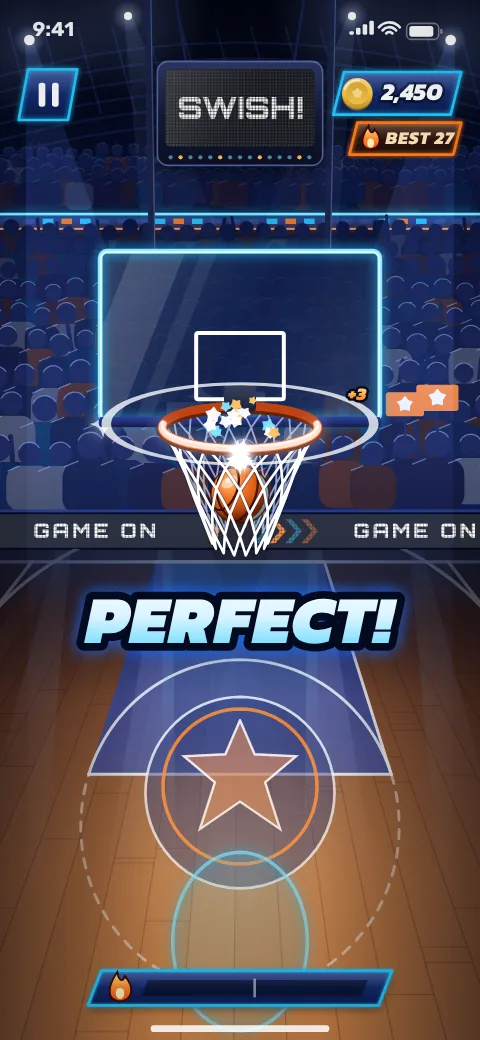
Three very different things called a sports game
"Sports game" covers a one-thumb basketball toy and a licensed football simulation with hundreds of real players. Those two products share a ball and very little else, so any cost answer has to start by naming which one you mean.
The arcade end is built around one gesture that feels good: flick to shoot, swipe to kick, tap to swing. The player is chasing a score or a streak, not managing a squad. The simulation end models positions, stamina, tactics and opponent AI for a whole team, and usually leans on a league license for names and logos. Between them sits a deeper arcade game with several arenas, characters and a cup or season structure.
| Scope | What it includes | DFY route | Typical studio range |
|---|---|---|---|
| Single flick-shot mode | One sport gesture, one arena, one mode, streak scoring, cosmetic unlocks, rewarded retry | Core Game $499, or Core Game + Launch $1,299 | $15,000 to $35,000 for a simple casual game |
| Deeper arcade sports | Two to four connected systems: several arenas or courts, a second mode such as a cup, characters, upgrades, opponent AI | Advanced Game + Launch $2,999 | $30,000 to $150,000 for casual with progression |
| Simulation, licenses or online play | Team tactics and match AI, real leagues, teams or players, realtime matches against other people | Custom quote (licenses are always the client's own deal) | Mid-core and simulation work runs from $300,000 to $1M+ |
Assumptions behind the table: iOS and Android from one project, 2D or lightweight 3D art, local save, no backend, original art and names. The studio ranges come from one studio's published 2026 estimate and are there for orientation only. Store developer accounts, ad spend and any license fees are extra in every row.
Sources: [S18]: Innovecs Games, How Much Does Mobile Game Development Cost in 2026? (opens in a new tab)
Arcade sports versus simulation sports
Every DFY package builds arcade sports. If your brief needs any item in the right-hand column below, it is a simulation project, and none of the package prices on this page apply to it.
| Area | Arcade sports (package scope) | Simulation sports (outside packages) |
|---|---|---|
| Physics | Tuned for feel: a forgiving arc, a ball that behaves the same way every time | Realistic ball, body and collision physics that must hold up across a full match |
| Animation | Hand-made or simple rigged animation for one character or none | Motion capture of real athletes, blended across hundreds of moves |
| Names and branding | Original teams, players, arenas and kits | Licensed leagues, clubs, players and stadiums, each with its own contract |
| Opponents | Moving targets, a simple rival or none | Team AI with positions, tactics and stamina |
| Session | Short runs, streaks and score chasing | Full matches, seasons, squads and transfers |
League and player licenses are negotiated with the rights holders, and that deal is always yours to make. Motion capture needs a studio, performers and an animation pipeline built around it. Neither fits a fixed package, so if your idea depends on either, ask for a custom quote or budget for a simulation studio.
What $499 buys in a flick-shot game
Our example arcade sports concept shows the Core shape. The loop is flick, swish, build a streak multiplier, miss, retry. The first shot is assisted with a faint arc preview, and the third introduces a moving hoop. Everything else in the game exists to make that one throw feel better: the net ripple, the crowd flash, the sound of a clean swish.
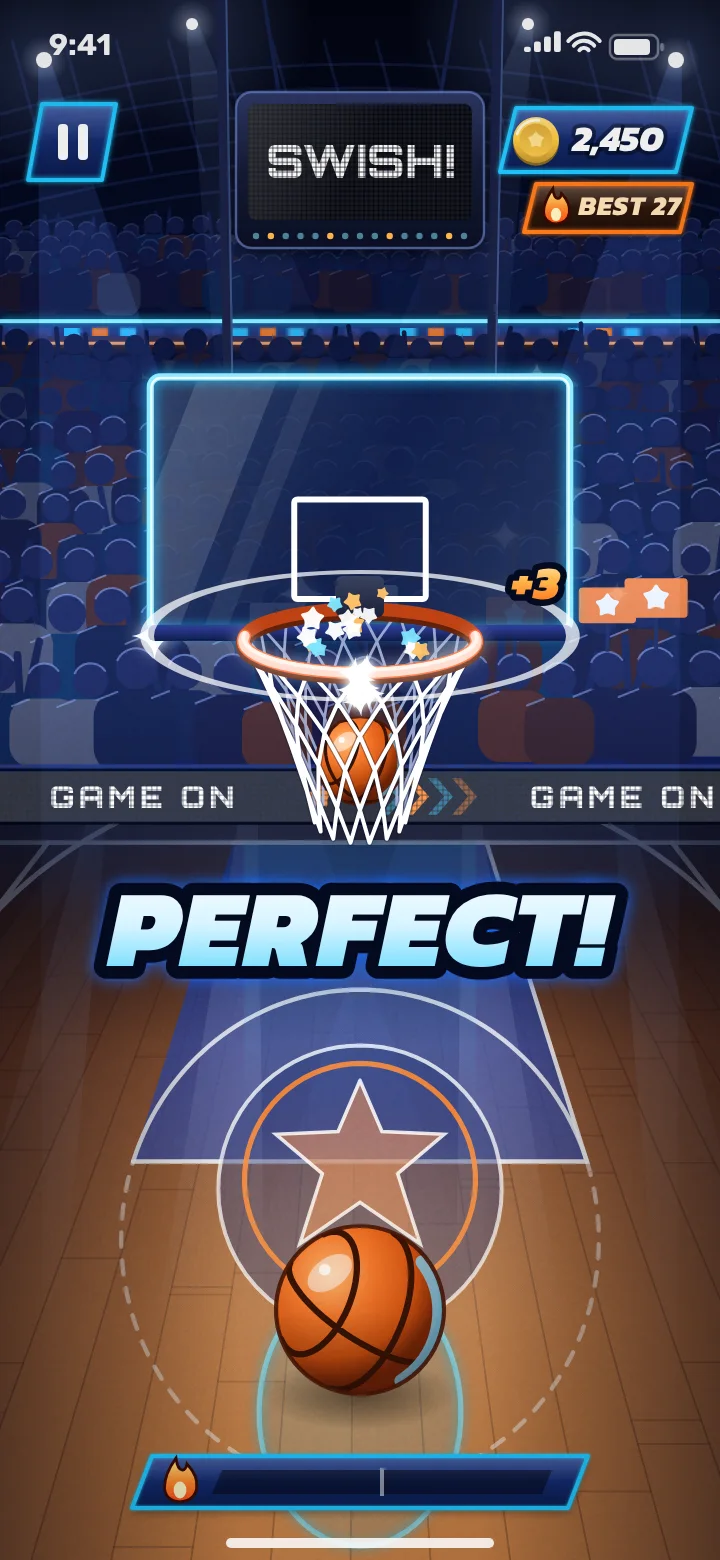
- One sport mechanic with tuned physics and touch response
- One arena or court, one game mode and a clear fail state
- Streak goals, local best score and cosmetic unlocks such as ball skins or court themes
- A rewarded-ad retry and up to two simple in-app purchases, for example a skin pack and remove-ads
- Internal QA, up to 15 invited playtesters, a store kit and one submission and review-response cycle
Core targets a submission-ready build within 10 business days after scope lock and complete intake. Google closed testing and both stores' reviews happen afterward and are controlled by Apple and Google. If you want creatives and 30 days of campaign management on top, Core Game + Launch is $1,299; ad spend is paid separately to the ad platforms.
What pushes a sports game out of Core
Sports ideas grow in predictable directions. Each row below is a reasonable feature, and each one adds a system with its own art, rules and testing. Read down the list and count how many you need for launch, not for year two.
| Feature | Why it costs more | Where it lands |
|---|---|---|
| Second arena or court | New art set, new physics tuning, new difficulty curve | Advanced (multiple arenas) |
| Second mode (cup, time attack, trick challenge) | New rules, new UI, its own balance and progression | Advanced (up to two modes when agreed) |
| Characters or teams with stats | Stat system, selection UI, balance between characters | Advanced |
| Opponent AI (goalkeeper, defender, rival shooter) | Behavior states, difficulty scaling, many more test cases | Simple patterns fit Core; broader AI is Advanced |
| Season or career structure | Calendar, standings, rewards economy, save data | Advanced |
| Realistic simulation physics | Ball spin, collisions, player bodies and animation blending | Custom quote |
| Realtime multiplayer | Servers, matchmaking, latency handling, cheating, running costs | Custom quote |
| Real leagues, teams or players | Third-party licenses, approvals and royalties | Outside the packages |
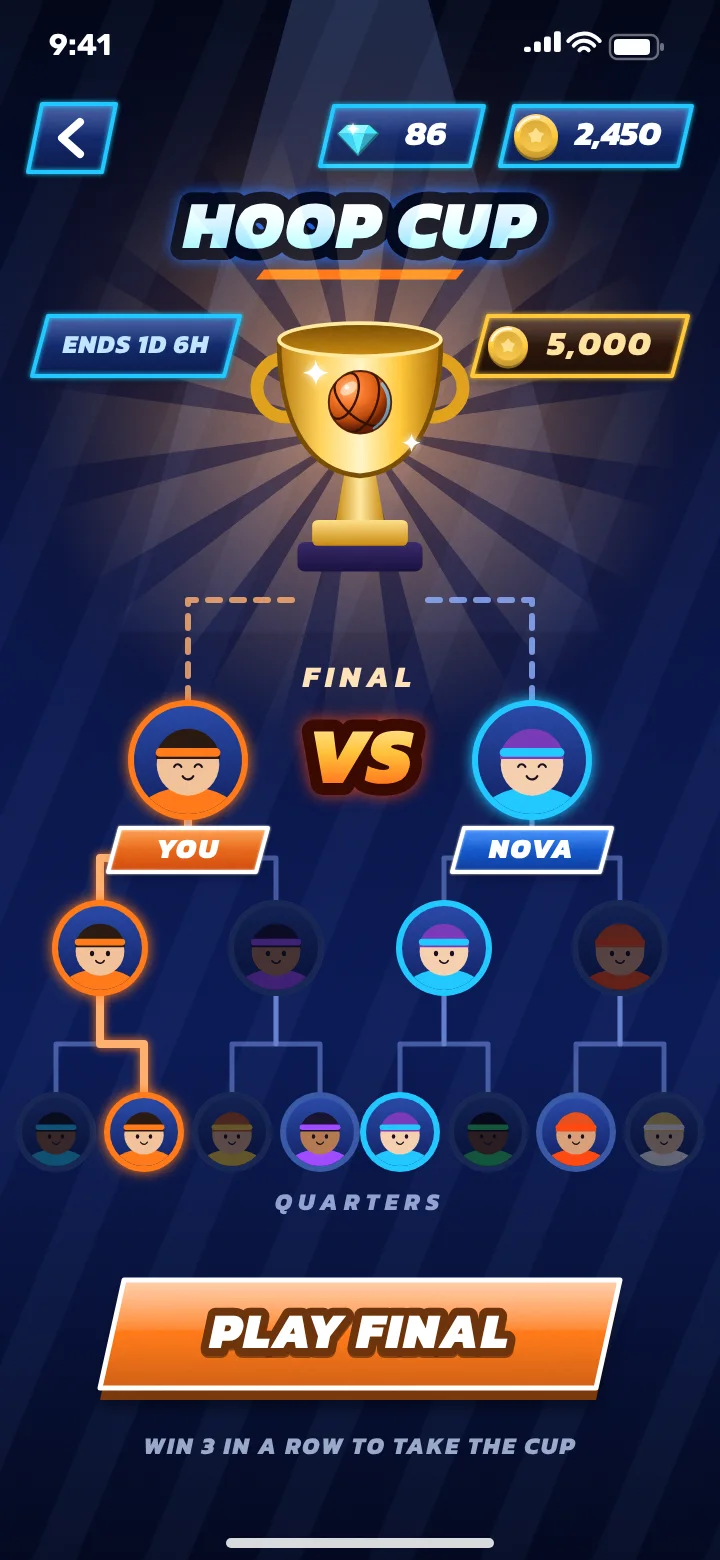
The bracket screen in our example concept is a good illustration. A weekend cup against computer opponents is a second mode with its own progression, so adding it to the single flick-shot game moves the build to Advanced. That can be the right call; it just should be a decision rather than a late addition. The comparison of build options covers the same line for other genres.
Why real leagues, teams and players are out of scope
League names, club badges, kit designs, stadium names and a player's name or face all belong to someone. Leagues and clubs own their trademarks, and player likeness is usually licensed through the players themselves or their association. Using any of it in a commercial game needs a license negotiated with the rights holder, which commonly involves approvals of how the brand appears, reporting and a royalty or minimum payment.
That is a business deal between you and the rights holder, and no development package can include it. DFY packages exclude licensed IP for that reason. Apple and Google also remove or reject apps that use trademarks without permission, so a game built with unlicensed club names carries a real risk of never reaching the store.
Multiplayer: what fits a package and what does not
Realtime head-to-head play means players' phones talk to a server during the match. Someone has to build and pay for that server, handle lag and disconnects, match players of similar skill and stop obvious cheating. It also keeps costing money after launch. That is why realtime multiplayer sits outside both packages and gets a custom quote.
Competition does not need a live server. Core can include a local best score or a simple platform achievement. Advanced can include leaderboards, share loops or asynchronous competition where the blueprint scopes them, such as beating a friend's posted streak. For a first release, a streak worth sharing usually carries more weight than a matchmaking queue with too few players in it.
The rest of the budget
Development is one line. You also need an Apple Developer Program membership ($99 a year) and a Google Play developer account ($25 one time). If you hire a studio by the hour instead of buying a package, rates in the same 2026 estimate run $62 to $150 in North America, $50 to $100 in Eastern Europe and $25 to $50 in Asia. Studios often budget user acquisition at 30-100% of the development cost. Next to a $499 build, marketing will usually be the larger number, so plan it before you plan the second mode.
For a wider view of how these lines add up across genres, read the mobile game development cost guide. When you are ready to describe your own idea, the companion guide on briefing an original arcade sports game walks through the touch controls and an originality checklist.
Sources: [S18]: Innovecs Games, How Much Does Mobile Game Development Cost in 2026? (opens in a new tab)[S19]: Apple Developer, Enrollment (opens in a new tab)[S20]: Google Play Console Help, Get started with Play Console (opens in a new tab)
When a fixed-price sports game fits, and when it does not
- Fits Core: you can describe the game as one gesture, one arena and one score to beat, and you want it in stores quickly to see whether players come back.
- Fits Advanced: you need a cup or career mode, several courts or characters with different stats, and you accept a full build of up to 30 days after a first playable in 10 business days.
- Custom quote: online matches, simulation physics or team management are the point of the game.
- Neither: the game only works with a real league or real players and you do not have that license yet. Secure the license first, or rework the idea around invented teams.
You can compare all three packages side by side on the pricing section, or go straight to checkout if the single-mode version already describes your game.
Frequently asked questions
How much does it cost to develop a simple sports game?
A single-mode arcade sports game fits the $499 Core Game package at DFY Games. One studio's 2026 estimate puts a simple casual game at $15,000 to $35,000 when built by the hour.
Can you build a game with real teams or players?
Not inside a package. Real leagues, teams and player likenesses need licenses from the rights holders, which are separate business deals; packages use invented names and teams.
Is online multiplayer included?
No. Realtime multiplayer needs servers, matchmaking and ongoing running costs, so it receives a custom quote; Advanced can include leaderboards or asynchronous competition where scoped.
Does a second game mode change the price?
Yes. Core covers one mode; a second mode such as a cup or time attack fits Advanced Game + Launch at $2,999 when it is agreed in the blueprint.
Is ad spend included in the launch packages?
No. Core Game + Launch and Advanced Game + Launch include creatives and 30 days of campaign management; you pay ad spend directly to the ad platforms.
Sources
- [S18] Innovecs Games, How Much Does Mobile Game Development Cost in 2026?
- [S19] Apple Developer, Enrollment
- [S20] Google Play Console Help, Get started with Play Console
Written and reviewed by the DFY Games team. Published ; facts checked . Prices and store rules change: check the linked sources before you rely on a figure.