Merge game cost at each scope
If you are looking for a merge game developer, the first thing to settle is which merge game you mean. The genre ranges from a single board with one chain to a long-running product with quests, energy, inventories and a weekly events calendar. Those are different budgets by an order of magnitude.
| Scope | Board and systems | Price | Timing |
|---|---|---|---|
| Core Game | One board, one primary merge chain, simple orders, limited boosters, finite progression path | $499 | Submission-ready build targeted in 10 business days |
| Core Game + Launch | The same build plus 16 launch creatives and 30 days of campaign management | $1,299 plus ad spend | Same build target; campaigns run 30 days |
| Advanced Game + Launch | Multiple chains or areas, energy and economy systems, quests, collections, events | $2,999 plus ad spend | First playable in 10 business days, full build within 30 days |
| Custom quote or ongoing work | Live operations: scheduled events, new chains, server-driven offers | Quoted | Monthly or per release |
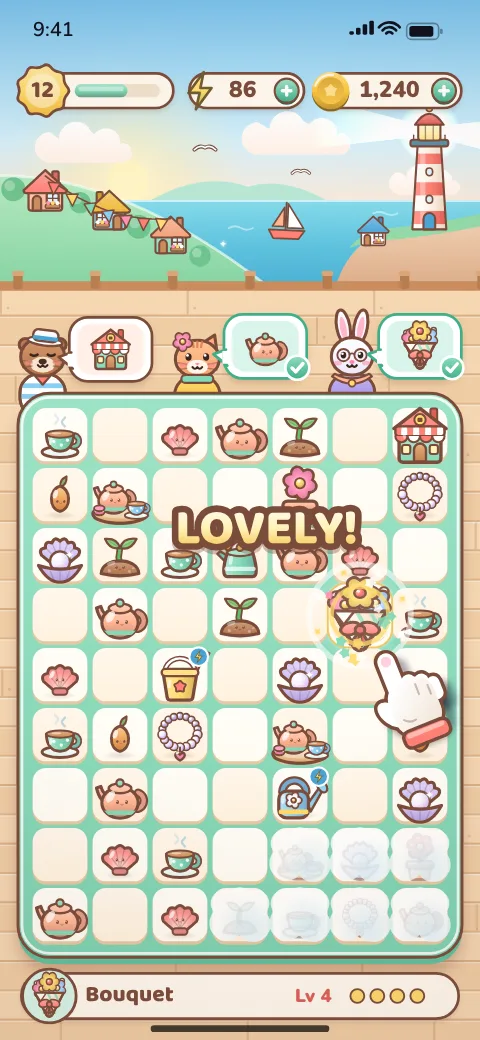
Our example merge concept, a seaside town restored one order at a time, is marked as fitting Core + Launch or Advanced. The merge game page explains both routes.
A small merge board compared with a full system stack
| Layer | Small board (Core) | With the layer added | Why it costs more |
|---|---|---|---|
| Orders and quests | Customers ask for one item; filling it pays coins and restores a spot in town | Multi-step quest lines with dialogue, rewards and dependencies | Quests need content writing, a tracking system and testing of every path |
| Inventory | None; the board is the only storage | Off-board storage slots, purchasable expansions | A second place items live, with UI, save logic and an economy around slots |
| Timers | None, or a light energy meter confirmed in the blueprint | Energy regeneration, generator cooldowns, timed chests | Timers need balancing against purchases and protection against clock changes |
| Chains | One primary chain | Several chains feeding each other | Each chain is a full art set, and cross-chain recipes multiply balancing |
| Live operations | None; the game is complete at launch | Seasonal events, reward tracks, new content on a schedule | Ongoing design, art, testing and usually a backend for remote content |
Worked example: three merge briefs
Counting the art: why chains drive merge cost
Merge games are art-heavy for their system size, because every tier of every chain is a separate item that has to be drawn, animated on merge and kept readable next to its neighbours. A quick count makes the difference between scopes concrete.
| Scope | Chains | Tiers per chain | Items to draw | Plus |
|---|---|---|---|---|
| Brief 1 | 1 | 6 | 6 | 1 generator, a handful of customers, one town area |
| Brief 2 | 3 | 6-8 | 18-24 | Generators per chain, quest characters, inventory UI |
| Brief 3 | 3 plus event chains | 6-8 | 24 and up, growing each event | Event boards, reward track art, offer screens |
Readability work scales with the count too. Our example merge concept keeps each item's silhouette close to the previous step so a chain reads at a glance, and every extra chain has to look distinct from the others on the same board.
Studio ranges and running costs
For a sense of the conventional market, Innovecs Games lists 2026 studio ranges of $30,000 to $150,000 for a casual game with progression and $80,000 to $250,000 for a puzzle game with light live operations. Brief 3 above belongs in or above that second band once the events calendar runs for months.
Live operations keep costing money every month they run. If you plan them, read the maintenance guide before you budget, and add Apple's $99 yearly developer fee, Google's $25 one-time fee and your ad spend.
Sources: [S18]: Innovecs Games, How Much Does Mobile Game Development Cost in 2026? (opens in a new tab)[S19]: Apple Developer, Enrollment (opens in a new tab)[S20]: Google Play Console Help, Get started with Play Console (opens in a new tab)
Which scope to commission first
Start with the smallest board that tests your theme. A merge game's appeal is the reveal of the next item and the feeling of a place being restored; both show up in Brief 1. If players respond, the quests, inventory and events can be added to a game you already own. The merge MVP guide lays out exactly what that first version should and should not contain.
If you already know the game must have energy, quests and events on day one, budget for Advanced and say so in the brief. You can start a merge game here, and the written blueprint confirms which tier the final scope needs.
Frequently asked questions
How much does it cost to make a merge game?
A one-board, one-chain merge game costs $499 as a DFY Core build or $1,299 with a launch campaign. A version with quests, energy, inventory and events is an Advanced build at $2,999.
What does a merge game developer usually charge?
Studio ranges for a casual game with progression run $30,000 to $150,000, with live operations adding ongoing cost on top.
Are energy timers included in the Core package?
Core covers one board, one chain and simple orders. A full energy system with timers and cooldowns is listed under Advanced; a light version is only included if the blueprint confirms it fits.
Can I add live events after launch?
Yes. You own the game files after full payment, and events or new chains can be added later under a separate quote.
Is ad spend included?
No. The launch packages include creatives and 30 days of campaign management; ad spend is paid directly to the ad platforms.
Sources
- [S18] Innovecs Games, How Much Does Mobile Game Development Cost in 2026?
- [S19] Apple Developer, Enrollment
- [S20] Google Play Console Help, Get started with Play Console
Written and reviewed by the DFY Games team. Published ; facts checked . Prices and store rules change: check the linked sources before you rely on a figure.